Does PCOS cause bloating? Why it happens and what helps
Bloating is common with PCOS, and its clearest link is irritable bowel syndrome. What studies show, what helps after meals, and when to see a doctor.
Bloating is one of the most commonly reported symptoms of PMOS (formerly PCOS), but nobody has shown that the condition causes it directly. The clearest link runs through irritable bowel syndrome: in a 2023 meta-analysis, the odds of IBS were more than twice as high in women with this condition, and IBS is one of the common causes of bloating. The everyday things that general guidance points to are ordinary ones: how much you eat at once and how fast, fizzy drinks, constipation, a particular group of carbohydrates, and for some people, the time of the month.
That is the short answer. The rest of this page covers why the link is less settled than it sounds, how bloating differs from swelling, what the general advice actually says, which kinds of bloating need a doctor, and how to find out which of your own meals are involved, which is the one part no study can do for you.
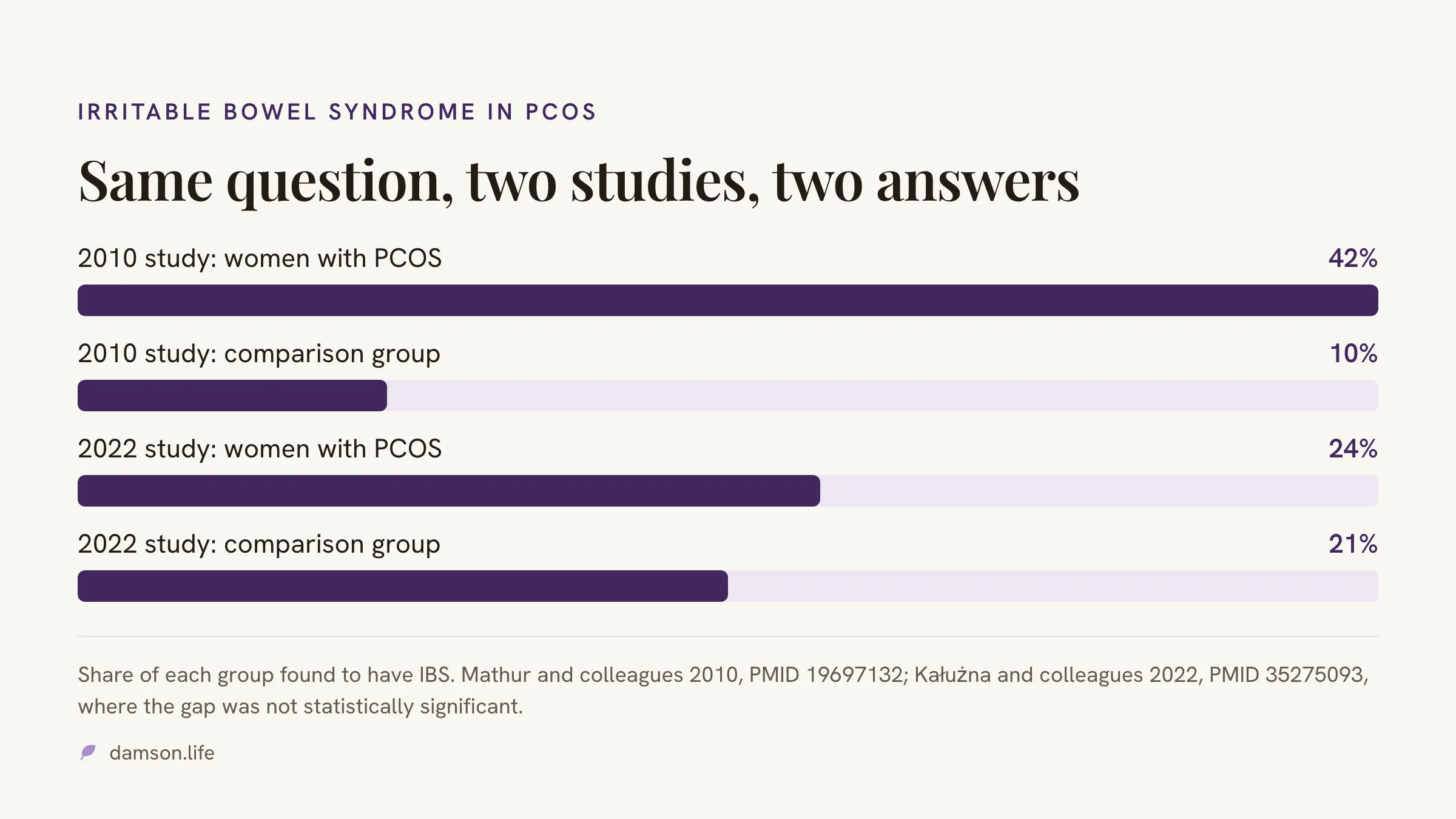
Same question, two studies, two very different answers.
Does PCOS cause bloating?
Bloating clearly matters to people with this condition. In what its authors describe as the largest known dataset on the condition, a chatbot survey run inside a period tracking app, bloating was the most frequently reported symptom among women who said they had the condition. It was self-reported, answered by people who chose to answer, and two of its authors are affiliated with the app’s maker, so it tells you what people experience rather than what causes it.
A much smaller study found bloating common too, along with a reason you may not have heard about it from a clinician. Researchers interviewed 20 women with the condition in depth: 60 per cent of them described bloating, and 95 per cent described irregular periods. Bloating was generally only mentioned once the interviewer asked about it directly, and the five clinical experts interviewed for the same study did not identify it as important to patients. Pain and discomfort made up 27.6 per cent of everything the women described, the largest share of any group, and the clinicians did not consider pain important to patients either. If you have raised bloating and felt it slide off the table, that gap has been documented.
Whether the condition causes bloating is a different question, and the research answer runs through IBS.
A 2023 meta-analysis pooled case-control studies comparing IBS in women with and without this condition. The odds of IBS were more than twice as high in women with the condition, an odds ratio of 2.23 (95 per cent confidence interval 1.58 to 3.14). The authors call the association significant and say more high-quality research is needed to make the conclusion robust.
The individual studies show why that caveat is there. In a 2010 study of 65 women, 42 per cent of the 36 with this condition had IBS, against 10 per cent of the comparison group, who were also leaner on average. In a 2022 study of 133 women with the condition and 72 comparison women matched for age and body mass index, using the Rome IV diagnostic criteria, IBS turned up in 24 per cent and 21 per cent, and the difference was not statistically significant. A 2024 review of six case-control studies, covering 793 women with the condition and 547 without, found IBS in 10 to 52 per cent of the women with the condition and 5 to 50 per cent of the comparison groups.
So the honest summary is this. Bloating is common in this condition. IBS is probably more common in it too, but how much more is not settled, and one careful study found no difference at all.
Why PCOS bloating happens: what is proposed, and what is known
The 2024 review lists the pathways that have been proposed to link this condition with IBS: metabolic syndrome, fluctuating sex hormones, disordered neurotransmitter signalling, psychological strain, and environmental and lifestyle factors. It concludes that it is still unclear which of these contributes most. Proposed is the operative word. Nobody has shown which one, if any, is doing the work.
What is well described is why bloating happens in general, in anyone. A 2021 review from gastroenterologists at the Mayo Clinic lists food intolerances, a previous gut infection that disturbed the gut’s bacteria, disordered sensation in the gut, and slow movement through the intestine among the causes. The NHS puts it more plainly: the most common reason is a lot of gas in the gut, from some foods and fizzy drinks or from swallowing air as you eat, and it can also come from constipation, a food intolerance, coeliac disease or IBS.
Two things on that list are especially relevant if you have this condition: your cycle, and your medication.
Bloating around your period
The NHS notes that some people feel bloated around the time of their period. In a survey of 156 healthy women with no gut, gynaecological or psychiatric condition, 62 per cent reported bloating in the five days before their period and 51 per cent during it. That study was not in this condition. If your cycles are irregular, as they were for 95 per cent of the women in the interview study above, a pattern tied to your period can be much harder to see without writing it down.
Bloating and metformin
Many people with this condition are prescribed metformin, and its best known side effects are in the gut. A 2023 meta-analysis of randomised trials in this condition, done to inform the international guideline, found mild gastrointestinal side effects considerably more common on metformin than on placebo, an odds ratio of 7.67 (95 per cent confidence interval 2.74 to 21.46). The guideline itself describes these side effects as mostly mild and transient, generally dependent on dose, and self-limiting, and says women should be told about them. Neither source breaks the side effects down into bloating specifically. The guideline also recommends raising doses of GLP-1 medicines gradually to reduce gut side effects.
If your bloating started or changed with a new medicine or a new dose, that is worth raising with whoever prescribed it. Do not stop or change a prescribed medicine on your own.
Bloating, swelling and distension are not the same thing
Searches for “PCOS swelling” and “PCOS belly bloat” often describe two different experiences, and telling them apart is one of the most useful things on this page.
The 2021 review draws the line clearly. Bloating is the feeling: trapped gas, pressure, fullness. Distension is a measurable increase in the size of your abdomen. The two often come together, but they can occur separately, so you can feel very bloated with no visible change, or look visibly swollen without much discomfort. The American Gastroenterological Association’s 2023 practice update adds belching as a third, separate symptom, and notes that belching and bloating differ in their causes, in how they are diagnosed, and in how they are managed.
In practice, it helps to note which one you had. “Tight and uncomfortable” and “my trousers stopped fitting by the evening” are different observations, and a clinician will want to know which.
Stomach pain and bloating after eating
Pain and bloating that come on after meals are part of the picture clinicians look for in IBS. NICE, which sets clinical guidance in England, says IBS should be considered when abdominal pain or discomfort is either relieved by opening your bowels or linked to a change in how often you go or what comes out, together with at least two of four other symptoms. Two of those four are bloating or distension, and symptoms made worse by eating.
Only a clinician can make that diagnosis, and part of making it is ruling other things out. NICE recommends a blood test for coeliac disease in people who meet the IBS criteria. The AGA update says blood tests can rule out coeliac disease in people with bloating, and that carbohydrate enzyme deficiencies can be ruled out with dietary restriction or breath testing. Both are diagnoses, not habits, and both are worth excluding before you start cutting foods.
The carbohydrates most often involved
If a group of foods is going to be implicated, it is usually the short-chain fermentable carbohydrates known by the acronym FODMAP (fermentable oligosaccharides, disaccharides, monosaccharides and polyols). A 2017 review in the journal Gut describes MRI studies showing that these carbohydrates increase the water in the small intestine and the gas produced in the colon, which brings on symptoms in people whose gut is more sensitive than usual.
The evidence that cutting them helps comes from IBS, not from this condition. A 2025 systematic review found fourteen randomised trials, ten of them in IBS, with diets lasting 3 to 12 weeks. Most of the IBS trials showed significant improvements in abdominal pain, bloating and quality of life compared with other diets. The authors say plainly that the diet may reduce symptoms in selected people, is not universally necessary, and needs supervision by a dietitian with experience in gut conditions, because of its restrictive nature and possible long-term effects on nutrition and on the gut’s bacteria.
It is also not meant to be permanent. A 2018 review from the team at King’s College London describes three stages: restriction, then reintroduction to identify which foods trigger symptoms, then a less restrictive personalised diet that leaves out only your own triggers. NICE says advice on this kind of diet should only come from a healthcare professional with expertise in dietary management, and only after general advice has not worked. The AGA update likewise says a gastroenterology dietitian should preferably oversee it.
What helps with bloating: the general advice
None of the advice below has been tested for bloating in this condition specifically. It is ordinary guidance for anyone, from the NHS and from NICE’s IBS guideline, and it is where to start.
From the NHS page on bloating:
- Eat smaller, more frequent meals instead of large ones, and avoid large meals late at night.
- Chew with your mouth closed, to avoid swallowing air, and do not slouch when you eat.
- Go easy on fizzy drinks, alcohol and caffeine.
- Exercise regularly, to help your digestion.
- Drink plenty of water.
- If you are constipated, eat foods high in soluble fibre, such as oats or linseed.
From NICE’s general diet advice for IBS:
- Have regular meals, take time to eat, and avoid long gaps between meals.
- Reduce alcohol and fizzy drinks.
- People with wind and bloating may find oats and linseeds helpful, up to a tablespoon of linseeds a day. There is more on oats in is oatmeal good for PCOS.
On probiotics, the two sources differ. The AGA update says probiotics should not be used to treat abdominal bloating and distension. NICE says people with IBS who choose to try one should take it for at least four weeks and monitor the effect. Where constipation is part of the picture, the AGA update says constipation medicines should be considered for the bloating, and the NHS notes that a pharmacist can advise on laxatives.
Notice how many of those points are about how you eat rather than what. The size of the meal, the pace and the gaps between meals come up again and again, and they are exactly the things a record of your own meals can show you.
When bloating needs a doctor
Bloating is very common and usually harmless, but not always. The NHS advises seeing a GP if:
- you feel bloated regularly
- you have tried changing your diet and still keep feeling bloated
- you have bloating and unintentional weight loss
- you have bloating and blood in your poo
It advises an urgent GP appointment, or calling 111 in the UK, if bloating comes with vomiting, diarrhoea or constipation, with a stomach ache, with a high temperature, with a swelling or lump in your tummy, or if you cannot pee, poo or fart. Call 999 or go to A&E if you have bloating with a swollen stomach and a severe stomach ache that came on suddenly, vomiting blood or vomit that looks like ground coffee, or severe difficulty breathing.
The NHS notes that bloating that does not go away can sometimes be a sign of something more serious, such as ovarian cancer. NICE advises tests when a woman, especially one aged 50 or over, has persistent abdominal distension (often called bloating), feeling full quickly or loss of appetite, pelvic or abdominal pain, or needing to pee more urgently or often, on a persistent or frequent basis, particularly more than 12 times a month. It also advises tests for anyone aged 50 or over whose IBS-like symptoms started within the last 12 months, because IBS rarely begins for the first time at that age. The NHS says to tell your GP if anyone in your family has had ovarian or breast cancer.
One finding from this condition is worth adding. In the 2022 study above, 87.5 per cent of the women who had both this condition and IBS reported at least one alarm symptom, and the authors say this highlights the need to rule out other diseases that can look like IBS. Persistent bloating is not something to accept as simply part of the condition.
What the evidence does not show
We searched for a trial of any diet for bloating specifically in this condition and did not find one. The FODMAP evidence is in IBS, the bloating guidance is general gastroenterology, and the studies linking this condition to IBS are observational and disagree about size.
The 2023 international guideline for this condition puts eating and other lifestyle changes at the front of care, describes its own evidence as generally low to moderate quality, and states that there is no evidence to support any one type of diet composition over another. So anyone telling you a named diet fixes bloating in this condition is going beyond what has been measured.
Finding your own after-meal pattern
Everything above narrows the search. None of it identifies what bloats you, because none of it measured you. Two people can eat the same lunch and one will be uncomfortable by mid-afternoon while the other notices nothing.
You are in a good position to run the one experiment that would answer it. Note what you ate in enough detail to repeat it, including roughly how much, how quickly and at what time. Then note what happened over the next few hours in your own words, including whether it was the feeling of bloating or visible swelling, and where you were in your cycle if you know. Do that for a few weeks and one of two things tends to happen. A pattern surfaces, often around the size of a particular meal, the pace, or a few specific foods, and you have something concrete to take to a clinician or a dietitian. Or no pattern appears, which tells you the plate may not be the main variable, and that is worth knowing too.
That loop is what we built Damson for. It is an iPhone app, on the App Store now. You record what you ate and how you felt afterwards, it describes the plate in terms of what was on it, and over time it shows you your own pattern rather than someone else’s average. You can correct anything it gets wrong. It does not diagnose anything, and it cannot tell you whether you have an intolerance; that is a job for your doctor. Keeping the record is free, and the full app is a subscription. A notes app will do the same basic job if you would rather not add another app.
Questions people ask
Does PCOS cause bloating? It has not been shown to cause it directly. Bloating is among the most commonly reported symptoms of the condition, and the clearest research link is irritable bowel syndrome, a common cause of bloating: a 2023 meta-analysis found the odds of IBS more than twice as high in women with the condition. The size of that link varies a lot between studies, and one found no difference.
Is PCOS bloating hormonal? Possibly, and nobody has shown it. Fluctuating sex hormones are on the list of proposed links between this condition and IBS, alongside metabolic, psychological and lifestyle factors, and the review that lists them says it is unclear which matters most. Bloating around periods is common in women without the condition too, so if yours comes and goes with your cycle, note it down.
Why do I get stomach pain and bloating after eating? Pain and bloating made worse by eating are part of the pattern clinicians look for in IBS, and the size and pace of a meal, fizzy drinks and fermentable carbohydrates are common contributors in anyone. If it happens after most meals, or keeps happening despite changes, see a GP, because coeliac disease and carbohydrate enzyme deficiencies can cause the same picture and both can be tested for.
Is PCOS swelling the same as bloating? Not quite. Bloating is the feeling of pressure and fullness; distension is a visible, measurable increase in the size of your abdomen. They often come together but can happen separately. A swelling or lump in your tummy, or a swollen tummy that is there most days, should be checked by a doctor.
Can metformin cause bloating? Metformin commonly causes mild gut side effects, which the international guideline describes as mostly transient and dependent on dose. The trials pooled for the guideline did not report bloating separately. If symptoms started with a new medicine or dose, talk to your prescriber rather than stopping it yourself.
How do I get rid of PCOS bloating? Start with the general advice: smaller and more regular meals, eating slowly, fewer fizzy drinks, dealing with constipation, and regular exercise. If that does not help, a GP can rule out other causes, and a low FODMAP diet is an option to try with a dietitian, not alone. No diet has been tested for bloating in this condition specifically.
Should I try a low FODMAP diet? Possibly, and not on your own. Most of the IBS trials found improvements in pain and bloating, and the reviews that gathered them say it should be supervised by a dietitian. It is a short process with a reintroduction stage, not a permanent way of eating.
The bottom line
Bloating is common with this condition, and it may be under-recognised in the clinic. The clearest research link is a raised rate of irritable bowel syndrome, though studies disagree about how raised. Your cycle and your medication can both play a part. Bloating and visible swelling are different things, and bloating that is persistent, comes with weight loss or bleeding, or starts after 50 needs a doctor. No diet has been tested for this symptom in this condition, so the list of triggers that matters is your own, and you find it by writing things down for a few unremarkable weeks.
Read next
Meal size turns up again in why am I so tired after eating with PCOS, where the portion matters more than what was in it.
If big meals follow long gaps because you are ravenous by the time you eat, why does PCOS make me so hungry is the companion piece.
Since the list that matters is yours, choosing a food diary you will still open in week three is the practical next step.
Damson keeps that list with you: a symptom tracker for the bloating itself, and meal check-ins that ask how each meal sat a few hours later.
Sources
- Jain T, Negris O, Brown D, Galic I, Salimgaraev R and Zhaunova L, characterization of polycystic ovary syndrome among Flo app users around the world, Reproductive Biology and Endocrinology 2021 PMID 33658043
- Martin ML, Halling K, Eek D, Krohe M and Paty J, understanding polycystic ovary syndrome from the patient perspective, a concept elicitation patient interview study, Health and Quality of Life Outcomes 2017 PMID 28821294
- Wei Z, Chen Z, Xiao W and Wu G, a systematic review and meta-analysis of the correlation between polycystic ovary syndrome and irritable bowel syndrome, Gynecological Endocrinology 2023 PMID 37494961
- Mathur R, Ko A, Hwang LJ, Low K, Azziz R and Pimentel M, polycystic ovary syndrome is associated with an increased prevalence of irritable bowel syndrome, Digestive Diseases and Sciences 2010 PMID 19697132
- Kałużna M and colleagues, are patients with polycystic ovary syndrome more prone to irritable bowel syndrome?, Endocrine Connections 2022 PMID 35275093
- Saei Ghare Naz M, Ghasemi V, Amirshekari S and Ramezani Tehrani F, polycystic ovary syndrome and irritable bowel syndrome, is there a common pathway, Endocrinology Diabetes and Metabolism 2024 PMID 38494583
- Lacy BE, Cangemi D and Vazquez-Roque M, management of chronic abdominal distension and bloating, Clinical Gastroenterology and Hepatology 2021 PMID 32246999
- Moshiree B, Drossman D and Shaukat A, American Gastroenterological Association clinical practice update on the evaluation and management of belching, abdominal bloating and distention, Gastroenterology 2023 PMID 37452811
- NHS, Bloating (page last reviewed 21 January 2026)
- NHS, Symptoms of ovarian cancer (page last reviewed 17 November 2025)
- NICE guideline NG12, Suspected cancer: recognition and referral, recommendations 1.5.2 to 1.5.5 on ovarian cancer (last updated 15 April 2026)
- NICE clinical guideline CG61, Irritable bowel syndrome in adults: diagnosis and management (last updated 4 April 2017)
- Bernstein MT and colleagues, gastrointestinal symptoms before and during menses in healthy women, BMC Women's Health 2014 PMID 24450290
- Melin J and colleagues, the impact of metformin with or without lifestyle modification versus placebo on polycystic ovary syndrome, a systematic review and meta-analysis of randomized controlled trials, European Journal of Endocrinology 2023 PMID 37536294
- Teede HJ and colleagues, recommendations from the 2023 international evidence-based guideline for the assessment and management of polycystic ovary syndrome, Human Reproduction 2023 PMID 37580037
- Staudacher HM and Whelan K, the low FODMAP diet, recent advances in understanding its mechanisms and efficacy in IBS, Gut 2017 PMID 28592442
- Whelan K, Martin LD, Staudacher HM and Lomer MCE, the low FODMAP diet in the management of irritable bowel syndrome, an evidence-based review of FODMAP restriction, reintroduction and personalisation in clinical practice, Journal of Human Nutrition and Dietetics 2018 PMID 29336079
- Kuźmin L, Kubiak K and Lange E, efficacy of a low FODMAP diet on the severity of gastrointestinal symptoms and quality of life, a systematic review of randomised controlled trials, Nutrients 2025 PMID 40573159
Damson is on the App Store.
Free to download, and the record is free to keep. No ads, and nothing to cancel later that you did not choose.
Download on the App Store