PMOS ICD-10 code: E28.2 stays. PMOS vs PCOS, explained
PCOS was renamed PMOS in May 2026. What changed and what did not: the diagnosis, the treatment, and the codes ICD-10 E28.2 and ICD-11 5A80.1.
PMOS (formerly PCOS) is the same condition under a new name. Polycystic ovary syndrome became polyendocrine metabolic ovarian syndrome on 12 May 2026. Nothing about the condition itself changed that day, and nothing about your diagnosis or your treatment changed either.
If that is all you came for, you can stop reading. What follows is the detail, because the detail is where the confusion sits: your notes still say the old name, some of your clinicians will still use it, and not everyone who works in this field thinks the change was a good idea.
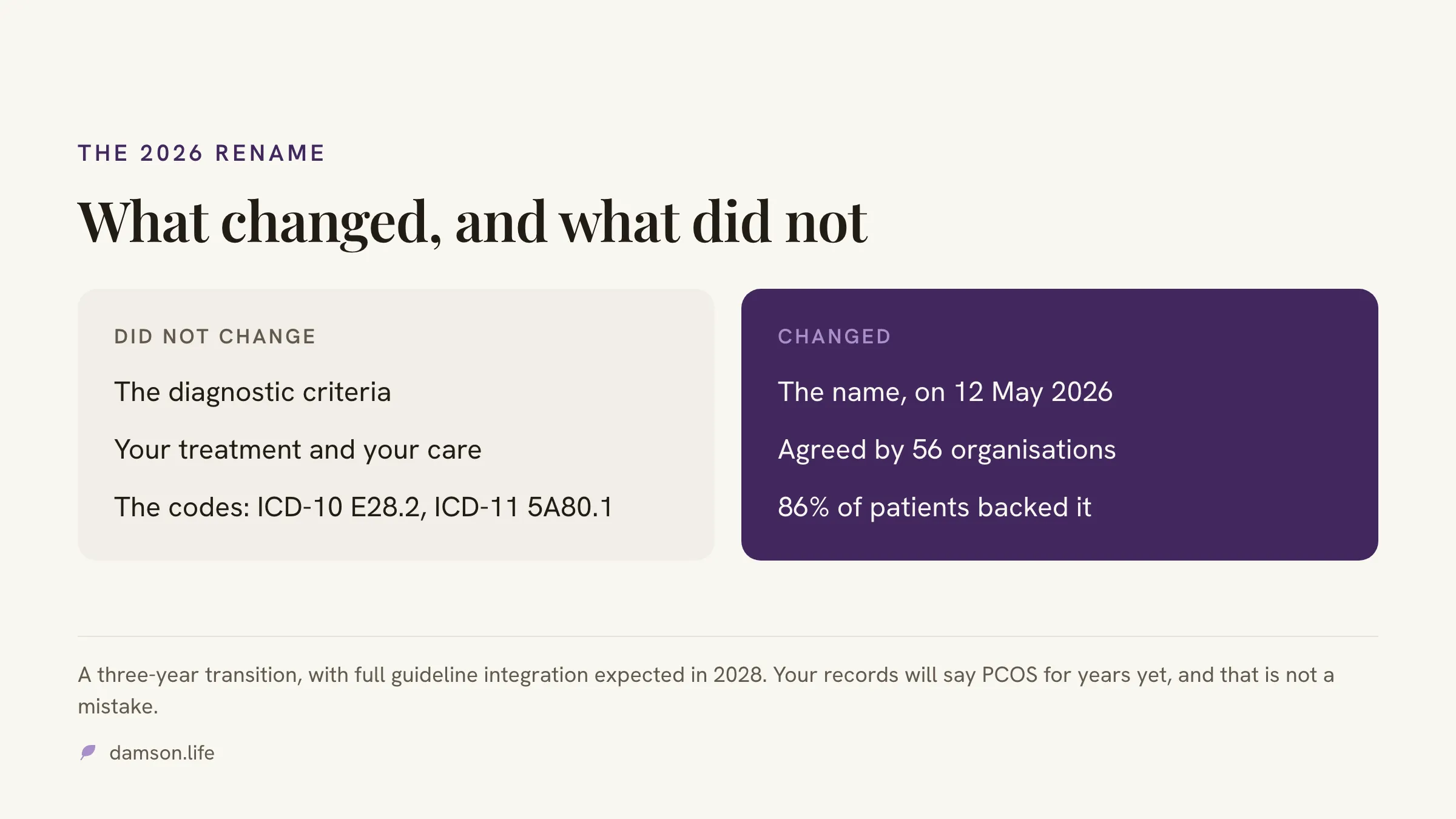
The half of the story most coverage skipped.
What actually happened
A consensus statement was published in The Lancet on 12 May 2026, announcing polyendocrine metabolic ovarian syndrome as the new name. It was not a press release or a campaign. It was the endpoint of a formal process, and the paper exists mainly to document how the decision was reached.
Fifty-six academic, clinical and patient organisations took part. The process used iterative global surveys, which drew responses from 14,360 people with the condition and multidisciplinary health professionals from every world region, alongside modified Delphi methods, workshops using nominal group technique, and analyses of how a new name could actually be implemented.
According to STAT News, which covered the announcement, the work began in October 2015 and ran through three surveys in 2017, 2023 and 2025, the last of which reached nearly fifteen thousand stakeholders. When a final vote was taken among ninety voters, eighty-seven supported the chosen name immediately and one more came round before the paper was submitted.
The Endocrine Society, one of the fifty-six organisations, describes the condition as affecting one in eight women, or more than 170 million worldwide.
Why they changed it
The stated reason is accuracy. The consensus paper argues that “polycystic ovary syndrome” implies pathological ovarian cysts, obscures the condition’s endocrine and metabolic features, and contributes to delayed diagnosis, fragmented care and stigma, while also narrowing how the condition is framed in research and policy.
The three words in the new name were chosen to correct that. “Polyendocrine” and “metabolic” put the hormonal and metabolic features into the name itself. “Ovarian” was kept because ovarian dysfunction is part of the picture. The word “cystic” was dropped because the follicles seen on a scan are not cysts in the sense the old name suggested.
The consensus group also considered whether to keep the familiar acronym and decided against prioritising it. An accurate name was ranked above a convenient one. That is a defensible call, and it is also the reason the change is slightly awkward: PMOS is one letter different from PCOS, which makes it easy to mistype and easy to misread.
What did not change
This is the half that most coverage skipped, and it is the half that affects your week.
The diagnostic codes still say the old name. The official description for the ICD-10-CM code used across US health systems, E28.2, is “Polycystic ovarian syndrome”. In ICD-11, version 2026-01, entry 5A80.1 is titled “Polycystic ovary syndrome”. Classification systems are revised on their own schedules, and until they are, your records, referrals, prescriptions and insurance paperwork will carry the old name. Seeing PCOS on a letter in 2027 will not mean anything has gone wrong.
The diagnostic criteria did not change. The consensus statement was about the name. Nothing in it altered what a diagnosis requires or how the condition is assessed.
Your care did not change. No treatment was added or withdrawn on 12 May 2026. The Endocrine Society says the new name is expected to be fully implemented in the 2028 international guideline update, which is when the recommendations themselves are next revised.
The old name will remain in use for years. The transition period is three years, supported by an international education and awareness campaign. Both names will be in circulation for the whole of it, and probably longer.
The major references have already switched, quietly
If you want to see what a gradual, dual-term transition looks like in practice, look at what the large medical references did. Cleveland Clinic’s page on the condition now carries the new name in its title and opens by naming both: polyendocrine metabolic ovarian syndrome, formerly known as polycystic ovary syndrome. The web address of that page still contains the old name.
That is the whole strategy, visible in one page. Change the heading, name both terms, leave the address alone so that nobody’s bookmark breaks and nobody searching for the old name gets lost. It is unglamorous and it is exactly right.
Not everyone agrees
The vote was close to unanimous among those who took part, and it would be dishonest to leave it there, because the dissent is real and it comes from inside the field.
STAT News quoted Angela Grassi, a dietitian who has worked in this area for many years, summarising her objection as “all this work to change a C to an M”. Her argument is practical: the rebranding costs fall on everyone who has written a book, built a service or named an organisation around the old acronym, and the change may not be the last one needed.
There is also a scientific objection, which is that keeping “ovarian” in the name closes off something the research is still working out. Some early work suggests there may be a male form of the condition, and a name built around the ovary cannot accommodate that. A commentary by Kordowitzki and Teede in Nature Metabolism discusses the new name in the wider context of the condition’s history, and the fact that a commentary was thought necessary at all tells you the conversation is not finished.
None of this means the change will be reversed. It does mean you will meet clinicians who use the old name deliberately rather than out of ignorance, and that is worth knowing before you correct anybody.
So which name should you use?
Whichever one gets you understood, which will usually be both.
In a consultation, saying “PCOS, which is now called PMOS” costs you two seconds and removes all ambiguity. In a search box, the old term still finds more, because two decades of writing sit under it. In a support group, follow the room. There is no wrong answer here and nobody is behind for using the name they were given at diagnosis.
The one place the distinction genuinely matters is paperwork. If a form, a code or a referral says polycystic ovary syndrome, that is current and correct, not out of date.
What we call it here
Both names, deliberately. We write “PMOS (formerly PCOS)” the first time each article mentions it, and then use whichever term reads more naturally. We keep the old term in page titles and web addresses, which is what the large medical references did, and for the same reason: it is what people are actually searching for.
We are not going to pretend the rename changes anything about what happens after you eat, either. The condition that made you look this up is the condition you had last month. A new name is a better label on the same box, and a better label is genuinely worth having, particularly one that stops implying your ovaries are full of cysts. It is just not a change to your Tuesday.
What can change your Tuesday is much smaller and much more local: knowing which of your own meals leave you comfortable and which do not. That is the loop we built Damson to hold, and it works the same under either name. It is on the App Store for iPhone.
Questions people ask
Is PMOS the same as PCOS? Yes. It is the same condition with the same diagnostic criteria and the same treatments. Only the name changed, on 12 May 2026, through a consensus process involving fifty-six organisations.
What is PCOS called now? Polyendocrine metabolic ovarian syndrome, shortened to PMOS. Both names are in use during a three-year transition, and the old name still appears in diagnostic coding systems.
Why did they drop “cystic” from the name? Because the consensus group judged it inaccurate. What appears on an ultrasound scan is a number of small follicles rather than cysts in the usual sense, and the old name put a misleading feature at the centre of the condition while leaving the hormonal and metabolic features out.
Do I need to tell my doctor about the new name? No. If they have not met it yet they will soon, and your notes will keep the old name for some time regardless. It is not something you have to manage.
Will the apps change their name to PMOS? Slowly, and mostly not yet. At the time of writing the Monash guideline library has renamed itself from AskPCOS to AskPMOS, and the rest of the category still says PCOS on the App Store. So if you are hunting for a PMOS app, search the old name for now. Our comparison of the food tracker apps on sale uses both names.
The bottom line
The name change is real, properly done, and much less dramatic than it sounds. Polycystic ovary syndrome is now polyendocrine metabolic ovarian syndrome, decided by fifty-six organisations after a decade of consultation, with a three-year transition and full guideline integration expected in 2028. The diagnostic codes, the criteria and the treatments are unchanged, the large references have switched their headings without moving their pages, and some respected people in the field still think the whole exercise was not worth the trouble. Use whichever name gets you understood, and do not let anybody tell you that the term you learned at diagnosis is wrong.
Read next
The practical writing on this site uses both names. The two questions people bring here most often are why do I get bloated after eating and why does PCOS make me so hungry.
If you are looking at apps and wondering which name they will use, the PCOS food tracker apps on sale in 2026, honestly compared covers what is on the store today.
If the rename has you thinking about your next appointment, Damson keeps a cycle log built for long cycles and puts your record on one page for your doctor, under whichever name you use.
Sources
- Teede HJ and colleagues for the Global Name Change Consortium, polyendocrine metabolic ovarian syndrome, the new name for polycystic ovary syndrome, a multistep global consensus process, The Lancet 2026 PMID 42119588
- Endocrine Society news release, 12 May 2026, new name to improve diagnosis and care of the condition affecting 170 million women worldwide
- STAT News, 12 May 2026, PCOS is now called PMOS, the renaming process lasted a decade
- US National Library of Medicine ICD-10-CM lookup, official description for diagnosis code E28.2
- ICD-11 for Mortality and Morbidity Statistics, version 2026-01, entry 5A80.1, as published in the ICD-11 code reference
- Cleveland Clinic health library entry for the condition, retitled to the new name at its existing web address
- Kordowitzki P and Teede H, polyendocrine metabolic ovarian syndrome, a new name for an old problem, Nature Metabolism 2026 PMID 42237044
- AskPMOS, the Monash Centre for Health Research and Implementation guideline library, renamed from AskPCOS
Damson is on the App Store.
Free to download, and the record is free to keep. No ads, and nothing to cancel later that you did not choose.
Download on the App Store