Why does PCOS make me so hungry?
The usual explanation is backwards: the main hunger hormone measures lower in PCOS, not higher. What the research found, and what it still disagrees about.
Hunger with PMOS (formerly PCOS) is real, and the most popular explanation for it is the wrong way round. The hormone most associated with hunger has been measured many times in this condition, and it runs lower rather than higher. What looks altered is not the loudness of the hunger signal but what a meal does to it afterwards, and even that is not settled. The best-evidenced thing that raises appetite in anyone, including you, is a short night’s sleep.
That is a smaller answer than the internet offers, and it leaves the useful question open. Whether your own hunger tracks the size of a meal, what was in it, or the night before it is not something a page can work out.
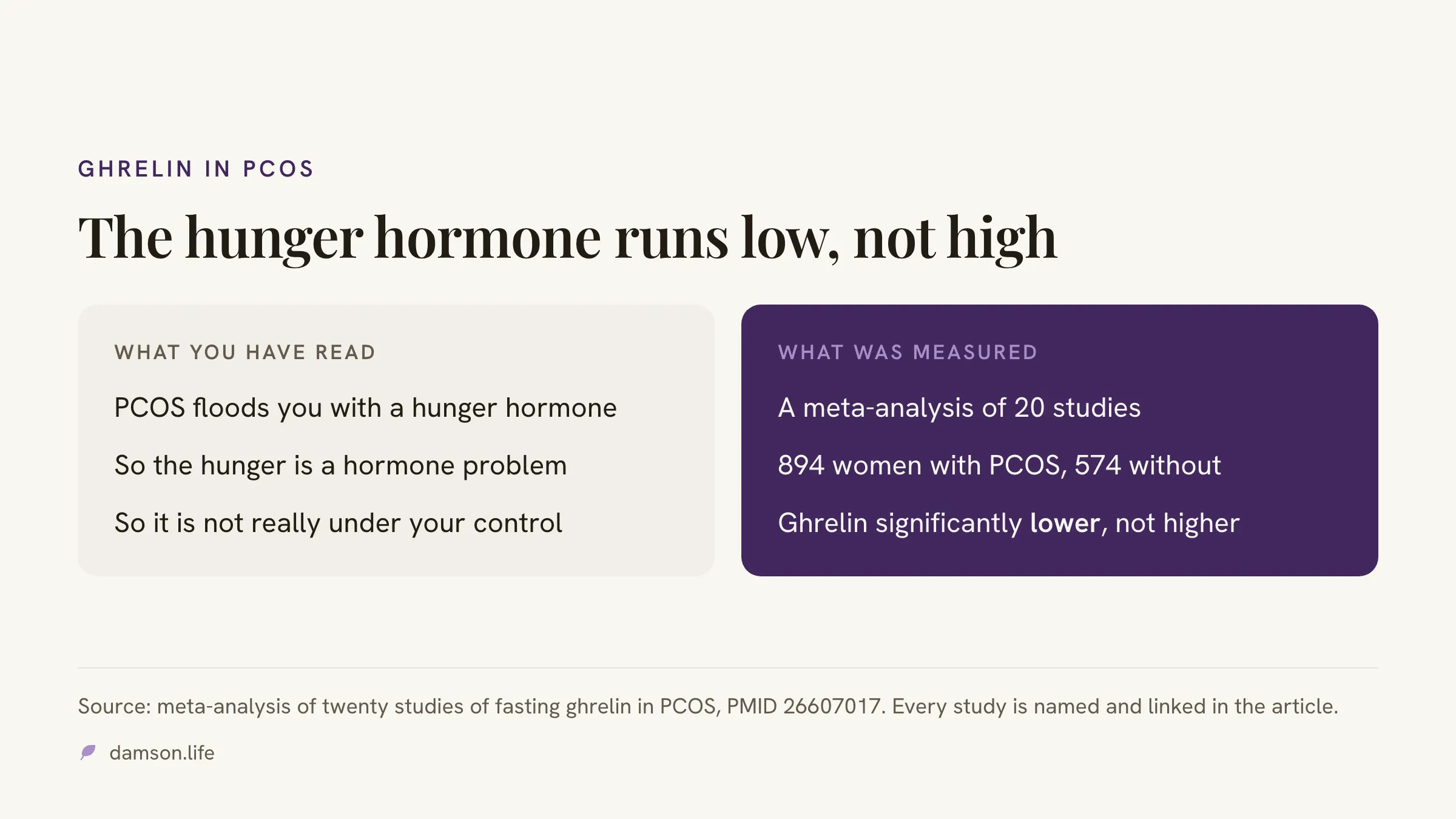
The claim most articles open with, beside the measurement.
The hunger hormone runs low, not high
Ghrelin rises before meals and falls after them, and it is the hormone most associated with appetite. If a condition made people hungrier by turning that signal up, ghrelin is where you would look first, and a great deal of confident writing implies that is what happened.
A 2016 systematic review and meta-analysis pooled twenty studies covering 894 women with this condition and 574 without. Circulating ghrelin was significantly lower in the women with the condition, with a standardised mean difference of minus 0.40 and a confidence interval from minus 0.73 to minus 0.08. The authors are careful, concluding that larger studies are warranted to replicate it.
Two individual studies point the same way. Among 32 overweight women, twenty with the condition and twelve without, those without it had roughly 70 per cent higher fasting ghrelin at baseline. In a study of 28 overweight women matched for age and weight, ghrelin was significantly lower in the group with the condition. So if you have read that this condition floods you with a hunger hormone, that is not what anyone has measured.
What a meal does to the signal, and where it stops being clear
The more interesting number in those two studies is not the level but the drop. Ghrelin is meant to fall after you eat, and that fall is part of how a meal registers. In the 2007 study the suppression after a test meal was smaller in the women with this condition, at the start and again after eight weeks, and the 2004 study found the same shape. The signal starts quieter and moves less.
A second hormone complicates it. Cholecystokinin, or CCK, is released by the gut during a meal and is one of the messages that ends it. A 2004 study gave a standardised meal to sixteen women with this condition and sixteen controls matched for age and body mass index. Those with the condition had a significantly lower meal-related CCK response, at a p value below 0.05. What matters is what that response was attached to: in the controls it tracked how satisfied they felt, and in the women with the condition it did not. The satiety message was quieter, and it appeared to have come unhooked from the sensation of having eaten.
Then the disagreement, which most articles skip because it does not resolve. The 2004 study also had participants rate hunger and fullness after a test meal, and those with the condition were less satisfied afterwards, at a p value of 0.001, and hungrier, at 0.007. The 2007 study went further, offering a buffet lunch people could eat freely from, and found no significant difference between the groups in appetite responses, in how much they ate, or in CCK and peptide YY.
Similar populations, opposite answers to the question you came here with. Blunted fullness after eating is a plausible feature of this condition rather than an established one: something researchers have found in some groups and failed to find in others.
The sugar craving question
The query that brings most people here is not really about hunger, it is about wanting something sweet, and the direct evidence in this condition is thin.
The same 2004 CCK study rated cravings. There was a tendency towards higher ratings of craving for sweets in the women with the condition, at a p value of 0.07, which did not reach significance. Within that group the craving ratings ran inversely with testosterone, which points the opposite way to the story usually told. One study, sixteen women, a result that did not reach the line.
Better established, and not specific to this condition: a 2020 review found that short-term, selective avoidance of a particular food appears to increase cravings for that food, and that craving behaves as a learned response rather than a fixed appetite. So if a named food has become louder since you decided it was off the list, that is a documented effect of the manoeuvre rather than a fact about you.
Sleep is the lever with the best evidence behind it
Nothing above is as well tested as this, and it is the part that gets left out.
A 2019 meta-analysis gathered 41 randomised controlled trials of sleep restriction in healthy adults. Restricting sleep increased subjective hunger by 13.4 millimetres on a 100 millimetre scale, and increased what people ate by about 253 kilocalories a day. The only thing that changed was the night before. An earlier crossover study shows the mechanism, using the same hormone from the top of this page: in twelve healthy young men studied after two days of short sleep and two of extended sleep, leptin fell by 18 per cent, ghrelin rose by 28 per cent, and hunger and appetite ratings rose by 24 and 23 per cent. Twelve young men in a laboratory are not you, so treat that as an illustration rather than a measurement of your Tuesday.
Why it matters more here: a meta-analysis of seventeen studies covering 648 participants found obstructive sleep apnoea in 35 per cent of women with this condition, and odds 3.83 times higher than controls. A wider review adds that the associations generally hold after adjusting for body mass index, and that sleep problems also occur in women with this condition who are of normal weight. That is a well-supported route to persistent hunger that has nothing to do with the plate.
What holds a meal, and the finding that complicates it
Composition does change how long a meal holds you, and the evidence is decent in general populations. In nineteen people, raising protein from 15 to 30 per cent of intake while holding calories constant markedly increased how satisfied participants felt. Viscous fibre is the other reliable component: in a crossover trial of 36 people given oatmeal, an equal calorie serving of corn flakes, or water, fullness was greatest and hunger lowest after the oatmeal, and the stomach emptied most slowly after it.
Now the complication. The 2004 study in this condition was itself a comparison of a higher protein diet against a standard one, and diet composition had no effect on fasting or post-meal ghrelin, nor on the measures of satiety. The one time anyone tested the protein idea inside this population, it came out null. That does not make protein and fibre useless. It means the general finding has not been reproduced here.
When hunger is worth taking to someone
A 2024 systematic review and meta-analysis pooled twenty studies covering 28,922 women with this condition and 258,619 without. The odds of any eating disorder were raised, at 1.53 with a confidence interval from 1.29 to 1.82. Binge eating disorder and bulimia nervosa were both more common; anorexia nervosa was not. This held regardless of weight, and the review informed the 2023 international guideline’s recommendation that clinicians consider the risk.
There is a version of this question that a page about satiety hormones is the wrong answer to. If hunger arrives in episodes that feel outside your control, or is distressing rather than inconvenient, that is a reason to talk to someone qualified rather than to reach for a stricter rule.
What the evidence does not show
Nobody has run a trial of any way of eating for hunger specifically in this condition. We looked. The appetite work is a handful of small studies, two of which disagree on whether fullness after a meal differs at all. The craving evidence is a single non-significant trend in sixteen women. The sleep restriction evidence is strong but general, and the studies of sleep disorders in this condition do not connect them to meals.
The 2023 international guideline puts eating and other lifestyle changes at the front of care while describing its own evidence base as generally low to moderate quality, and it endorses no particular dietary composition. Any page that tells you which breakfast ends your hunger is telling you something nobody has measured.
Why the real answer is personal
The research narrows the search to a short list and then stops: the size of the last meal, what was in it, how long ago it was, or how you slept. Averages cannot tell you which, because they were taken across people who were not you.
Finding out is unremarkable work, and it does not require weighing anything. Note what you ate in enough detail to repeat it, roughly how much and when. Then note when hunger next arrived, in your own words rather than as a score, and last night’s sleep in a single word. Read it back after three weeks rather than interpreting each day as it happens. What surfaces is usually duller than any general claim: the same lunch holds you until six on some days and until three on others, and the difference was rarely the lunch.
That loop is what we built Damson for. It holds the record, describes the meal by what was in it, and shows you your own pattern instead of someone else’s average. It is on the App Store for iPhone, and a notebook does the same job if you would rather not use an app.
Questions people ask
Why does PCOS make me so hungry? No study has established that it does, and the popular explanation is backwards: ghrelin measures lower in this condition, not higher, across a meta-analysis of twenty studies. What has been observed is a smaller fall in ghrelin after eating, and in one small study a reduced CCK response not attached to the feeling of fullness.
Why am I still hungry after eating? Possibly because the meal was less filling than it looked, and possibly because of the night before. Restricting sleep raised hunger by 13.4 millimetres on a 100 millimetre scale across 41 randomised trials, and sleep disorders are more common in this condition, including in women who are not overweight. That is worth checking before adjusting the plate.
Why do I crave sugar with PCOS? The direct evidence is one study of sixteen women that found a tendency towards higher sweet cravings which did not reach statistical significance. Better supported, and general: short-term avoidance of a specific food increases cravings for it, so a craving that got louder after you ruled something out may be the ruling out rather than the condition.
The bottom line
The hunger is real and the standard explanation for it is not supported. Ghrelin measures lower in this condition, not higher, and what looks altered is the size of its fall after a meal rather than its volume. One small study found a satiety signal that had come apart from the sensation of fullness; a later study found nothing of the kind, so the honest status is unsettled. The strongest evidence belongs to sleep, which raises hunger measurably in controlled trials and is disturbed more often in this condition at every weight. Everything after that is your own record.
Read next
If the hunger shows up as thoughts rather than as an empty stomach, what food noise is and what quietens it covers the same ground from the other side.
The sleep evidence here explains a good deal of tiredness after eating as well, which is worth knowing before you start adjusting lunch.
And if the question underneath all of this was whether one food is the problem, can I eat rice with PCOS works through one in detail.
Craving is one of the four answers Damson asks for a few hours after a meal, and patterns drawn from your own days are where those answers add up.
Sources
- Gao T, Wu L, Chang F and Cao G, low circulating ghrelin levels in women with polycystic ovary syndrome, a systematic review and meta-analysis, Endocrine Journal 2016 PMID 26607017
- Moran LJ and colleagues, ghrelin and measures of satiety are altered in polycystic ovary syndrome but not differentially affected by diet composition, Journal of Clinical Endocrinology and Metabolism 2004 PMID 15240612
- Moran LJ and colleagues, postprandial ghrelin, cholecystokinin, peptide YY and appetite before and after weight loss in overweight women with and without polycystic ovary syndrome, American Journal of Clinical Nutrition 2007 PMID 18065576
- Hirschberg AL, Naessen S, Stridsberg M, Bystrom B and Holtet J, impaired cholecystokinin secretion and disturbed appetite regulation in women with polycystic ovary syndrome, Gynecological Endocrinology 2004 PMID 15624269
- Zhu B, Shi C, Park CG, Zhao X and Reutrakul S, effects of sleep restriction on metabolism-related parameters in healthy adults, a comprehensive review and meta-analysis of randomised controlled trials, Sleep Medicine Reviews 2019 PMID 30870662
- Spiegel K, Tasali E, Penev P and Van Cauter E, sleep curtailment in healthy young men is associated with decreased leptin levels, elevated ghrelin levels, and increased hunger and appetite, Annals of Internal Medicine 2004 PMID 15583226
- Kahal H and colleagues, the prevalence of obstructive sleep apnoea in women with polycystic ovary syndrome, a systematic review and meta-analysis, Sleep and Breathing 2020 PMID 31111411
- Fernandez RC and colleagues, sleep disturbances in women with polycystic ovary syndrome, prevalence, pathophysiology, impact and management strategies, Nature and Science of Sleep 2018 PMID 29440941
- Weigle DS and colleagues, a high-protein diet induces sustained reductions in appetite and ad libitum caloric intake, American Journal of Clinical Nutrition 2005 PMID 16002798
- Geliebter A and colleagues, effects of oatmeal and corn flakes cereal breakfasts on satiety and gastric emptying, Annals of Nutrition and Metabolism 2015 PMID 25612907
- Meule A, the psychology of food cravings, the role of food deprivation, Current Nutrition Reports 2020 PMID 32578025
- Cooney LG and colleagues, increased prevalence of binge eating disorder and bulimia nervosa in women with polycystic ovary syndrome, a systematic review and meta-analysis, Journal of Clinical Endocrinology and Metabolism 2024 PMID 39115340
- Teede HJ and colleagues, recommendations from the 2023 international evidence-based guideline for the assessment and management of polycystic ovary syndrome, Human Reproduction 2023 PMID 37580037
Damson is on the App Store.
Free to download, and the record is free to keep. No ads, and nothing to cancel later that you did not choose.
Download on the App Store