Is oatmeal good for PCOS? What the research shows
Oats kept people fuller than dry cereal in trials, and oat fibre modestly lowers cholesterol. What was tested, what was not, and how to build a bowl that lasts the morning.
Oatmeal is a reasonable breakfast if you have PMOS (formerly PCOS), and the honest reason is narrower than the internet suggests. The trials on oats measured fullness, digestion and cholesterol. None of them was done in this condition. The variables that matter are the type of oat, the portion, and what you add.
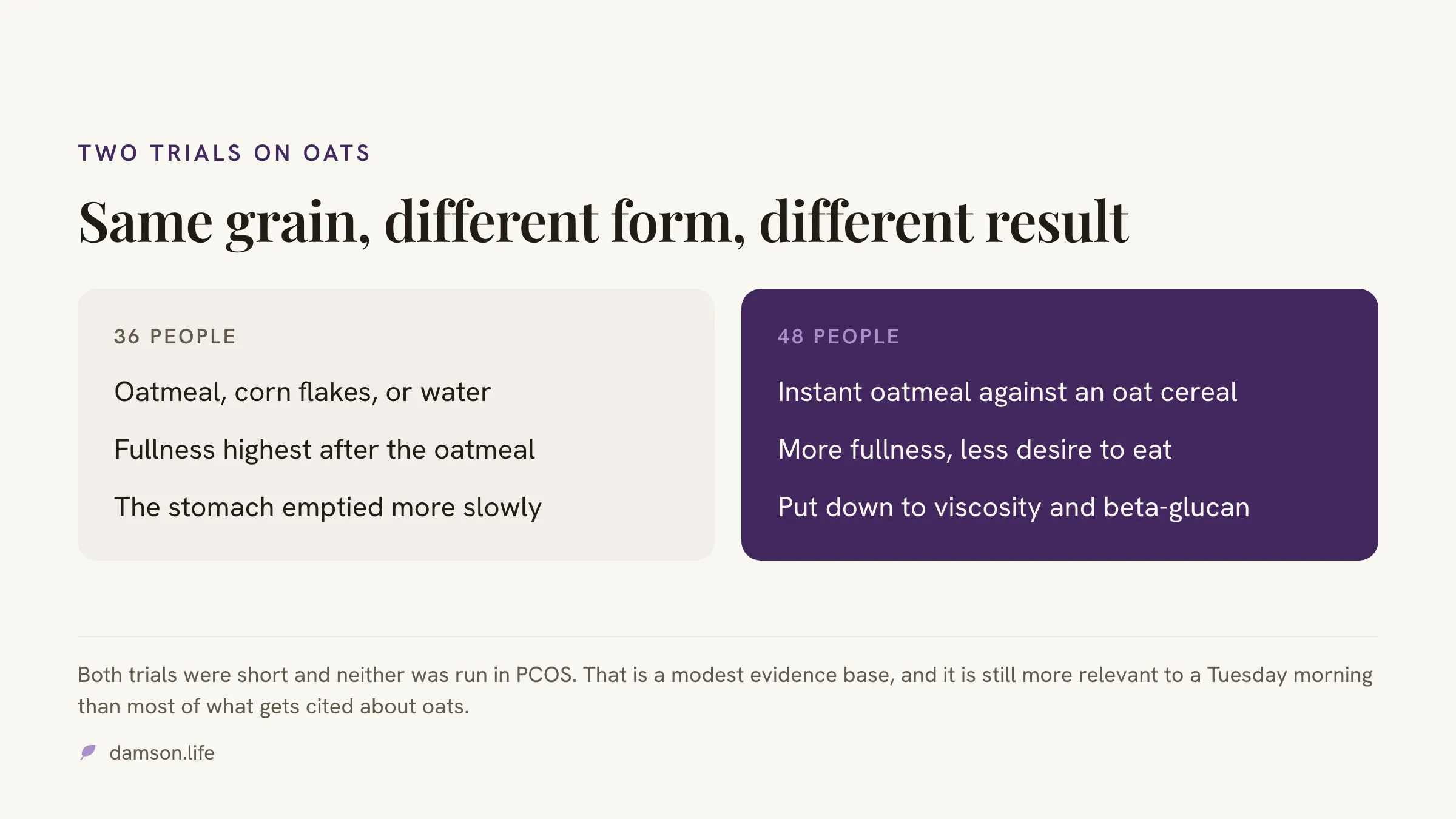
Both breakfasts in the second trial were made of oats.
What the research actually measured
Two trials are worth knowing about, because they tested the thing people are really asking: does porridge hold you.
In one, 36 people were given oatmeal, an equal calorie serving of corn flakes, or water. Fullness was greatest and hunger lowest after the oatmeal, they ate less at the lunch that followed, and the stomach emptied more slowly after the oatmeal than after the corn flakes. The slower emptying is the mechanism, and it is a digestion mechanism rather than anything more mysterious.
In the other, 48 people took part in a randomised crossover trial comparing instant oatmeal with a ready to eat oat based breakfast cereal. The oatmeal produced more fullness and less hunger, less desire to eat and a lower expectation of eating more later. The authors attributed the difference to viscosity and to the beta-glucan in the oatmeal, which matters because both breakfasts were made of oats. Same grain, different form, different result.
Both trials were short, both were in people without this condition, and both were measuring feelings alongside a lunch. That is a modest evidence base. It is also more directly relevant to a Tuesday morning than most of what gets cited about oats.
What is actually in oats
The interesting ingredient in oats is beta-glucan, a soluble fibre that becomes viscous in water. That viscosity is why porridge is thick, and it is the reason oats behave differently from a dry flake of the same grain.
Beta-glucan has been studied most thoroughly for cholesterol. A meta-analysis of 28 randomised controlled trials found that at three grams a day or more, oat beta-glucan reduced LDL cholesterol by 0.25 millimoles per litre and total cholesterol by 0.30 millimoles per litre compared with control, with no significant effect on HDL cholesterol or triglycerides. Those are real, replicated and modest effects, and they are about cholesterol. They are not a finding about this condition, and we are not going to dress them up as one.
Beyond the beta-glucan, oats bring a useful amount of protein for a grain and, unlike most breakfast cereals, arrive without needing anything added to be palatable. The gap most oat breakfasts have is protein, which is easy to close.
Steel cut, rolled, instant: does the type matter?
Somewhat, and less than the marketing implies. The differences that matter are physical and practical rather than moral.
Steel cut oats are the coarsest and take the longest to cook. Rolled oats are flattened and cook faster. Instant oats are cut, rolled thinner and often pre cooked, which is precisely the form that performed well in the crossover trial above, so instant is not automatically the poor relation. What does separate the sachets from the rest is what is in them: flavoured instant sachets frequently carry a good deal of added sugar, and the serving is often small.
There is a quick label test for this. Researchers comparing five methods of identifying better grain products across 545 items found that a simple ratio, ten grams of carbohydrate or fewer for every gram of fibre, picked out products with more fibre and less sugar than the industry whole grain stamp did. Turn the packet over, divide the carbohydrate by the fibre, and you will learn more in ten seconds than the front of the box will tell you.
What you add matters more than which oat you buy
A bowl of oats and water is mostly starch and fibre. What arrives with it decides how the morning goes.
Protein is the usual missing piece: Greek yoghurt, milk, a spoon of nut butter, an egg on the side if savoury oats appeal to you. Fat with some substance, such as nuts or seeds, slows things further and makes the bowl more satisfying. Berries add fibre and volume for very little else. Salt, cinnamon or vanilla can do the work that two spoons of sugar were doing.
None of that is specific to this condition and we will not pretend otherwise. It is ordinary composition, ordinary satiety, and it is the part you can actually feel by mid morning, which is why it is worth attending to.
What the evidence does not show
Nobody has run a trial of oatmeal in this condition. We looked, and if one exists we have not found it. So any page telling you that oats correct your hormones is telling you something the literature does not support.
The wider picture is consistent with that caution. The 2023 international guideline puts eating and other lifestyle changes at the front of care while describing its own evidence base as generally low to moderate quality. The systematic review commissioned to inform it compared diets of different composition and found that improvements happened regardless of composition, with no one pattern coming out ahead. Against that background, the claim that a specific breakfast is decisive is not a modest claim, it is an unsupported one.
What can be said is smaller and firmer. Oats bring a fibre that has been well studied, in a form that tends to hold people for longer than a dry cereal does, and they are cheap and easy to make. That is a decent case for a breakfast. It is not a treatment.
Why the real answer is personal
Trials describe averages, and you are not an average. In the corn flakes trial, the group as a whole felt fuller after the oatmeal, which tells you nothing certain about your own eleven o’clock.
Some people find porridge sees them comfortably to lunch. Others find a bowl of oats leaves them hungry within the hour, and the fix is usually protein rather than abandoning oats. A few genuinely do better on eggs. All three of those are real, and the only way to know which one you are is to watch what happens after you eat.
The method is unglamorous. Record the breakfast in enough detail to repeat it, including what you added and roughly how much. Then record how you felt an hour or two later, in your own words rather than as a number. Repeat the same breakfast on a few different mornings so you are comparing like with like. After three or four repetitions you will know more about oats and you than any article can tell you, including this one.
That loop is what we built Damson for: it holds the record, it explains the bowl in terms of what was in it, and it lets you notice your own pattern rather than handing you someone else’s. It is on the App Store for iPhone. A paper notebook does the same job if you would rather not use an app.
Questions people ask
Is oatmeal good for PCOS? It is a reasonable, well made breakfast with a fibre that has been properly studied, and there is no trial showing it does anything specific for the condition. If it holds you until lunch and you enjoy it, that is a good enough reason to keep it.
Are overnight oats better than cooked porridge? Nobody has compared them properly for this. Overnight oats are softer and often made with yoghurt or milk, which usefully adds protein. Cooked porridge is warmer and thicker. Choose on preference and on what you add, not on a hierarchy.
Which oats should I buy, steel cut or instant? Buy the ones you will actually make. Plain oats of any cut are fine. If you are buying flavoured sachets, check the label: divide the carbohydrate by the fibre, and look at how much sugar is in a serving that small.
Why am I hungry an hour after porridge? Most often because the bowl was mostly starch. Try the same oats with a protein beside them, yoghurt, milk, nuts or an egg, and see whether the morning changes. If it does not, oats may simply not be your breakfast, and that is allowed.
The bottom line
Oats are worth eating and they are not medicine. The trials show more fullness, less hunger and slower digestion compared with dry cereal, and a well replicated modest effect on cholesterol from beta-glucan at three grams a day or more. None of that was measured in this condition, and the guideline that governs it is honest about how thin the dietary evidence is. So make the bowl properly, add protein, read the sachet, and then let your own record settle the question for you.
Read next
The other grain people ask about most is rice, and the answer there is more interesting than it looks.
If the reason you are asking about breakfast is that you are hungry by eleven, why does PCOS make me so hungry is the fuller answer.
And if the thoughts about food are the harder part of the morning, what food noise is and what quietens it.
To find out which bowl lasts your morning, Damson’s food scanner reads a photo of it in plain sentences, and a few hours later asks how it sat.
Sources
- Geliebter A and colleagues, effects of oatmeal and corn flakes cereal breakfasts on satiety and gastric emptying, Annals of Nutrition and Metabolism 2015 PMID 25612907
- Rebello CJ and colleagues, randomised crossover trial of instant oatmeal against a ready-to-eat oat-based breakfast cereal, Journal of the American College of Nutrition 2016 PMID 26273900
- Whitehead A, Beck EJ, Tosh S and Wolever TM, cholesterol-lowering effects of oat beta-glucan, a meta-analysis of randomised controlled trials, American Journal of Clinical Nutrition 2014 PMID 25411276
- Mozaffarian RS and colleagues, identifying whole grain foods, a comparison of different approaches for selecting more healthful whole grain products, Public Health Nutrition 2013 PMID 23286205
- Teede HJ and colleagues, recommendations from the 2023 international evidence-based guideline for the assessment and management of polycystic ovary syndrome, Human Reproduction 2023 PMID 37580037
- Moran LJ and colleagues, dietary composition in the treatment of polycystic ovary syndrome, a systematic review to inform evidence-based guidelines, Journal of the Academy of Nutrition and Dietetics 2013 PMID 23420000
Damson is on the App Store.
Free to download, and the record is free to keep. No ads, and nothing to cancel later that you did not choose.
Download on the App Store