Why am I so tired after eating with PCOS?
Feeling tired after meals is real, and the meal is rarely the whole of it. What the research on the afternoon dip, meal size and sleep actually shows.
Feeling tired after eating with PMOS (formerly PCOS) usually has more than one cause, and the meal is rarely the whole of it. Portion size, the hour of the day and how you slept the night before all contribute, and sleep disturbance is measurably more common in this condition than outside it.
Which of those is doing the most work in your case is not something a page can tell you. But the list is short, the variables are visible, and a few weeks of attention will usually identify the one that matters to you.
The largest analysis of the question found neither half of the usual explanation.
The afternoon dip is mostly not about lunch
Start here, because it reframes the question. The mid-afternoon flatness that everyone attributes to lunch has been studied directly, and the researchers who study it describe it as a bi-circadian phenomenon, largely unrelated to lunch, and made worse by a disturbed night’s sleep beforehand. In other words, a dip arrives in the early afternoon whether or not you eat, because of the shape of the body clock, and how bad it is depends more on last night than on the sandwich.
That does not mean the meal contributes nothing. A driving simulator study tested it properly. Twelve young men, whose sleep had been restricted to five hours the night before, drove a monotonous two-hour afternoon route after either a light lunch of 305 calories or a heavy one of 922 calories, given double blind. The heavy lunch produced significantly more sleepiness-related lane drifting and significantly more of the brainwave activity that indicates sleepiness, plus a trend towards feeling sleepier. Both lunches got worse over the drive.
Two details are worth carrying with you. There was no difference between the two lunches for at least the first thirty minutes; the gap opened after that. And the honest limitation: twelve young men, sleep-deprived on purpose, in a car simulator, which is not you. What the study supports is narrow and useful: a large meal worsens a sleepiness that was already there. It does not support the idea that lunch creates the dip.
Size matters more than composition
Here is the finding most articles get backwards. A 1997 study put ten healthy men through two protocols, measuring how quickly they fell asleep in naps taken at intervals after eating. Solid meals produced significantly shorter times to sleep onset than an equivalent volume of water. But when the researchers compared meals high in fat, high in carbohydrate, or mixed, they found no meaningful difference. The composition of the meal did not affect how sleepy people became. The fact of having eaten a solid meal did.
Ten men in a sleep laboratory is not the last word on anything. It is, however, a direct test of the claim the internet makes most confidently, and it came out against it.
The carbohydrate story is not what you were told
The standard explanation for post-meal tiredness is that carbohydrate gives you a lift and then takes it away. The largest analysis of this question found neither half of that sentence.
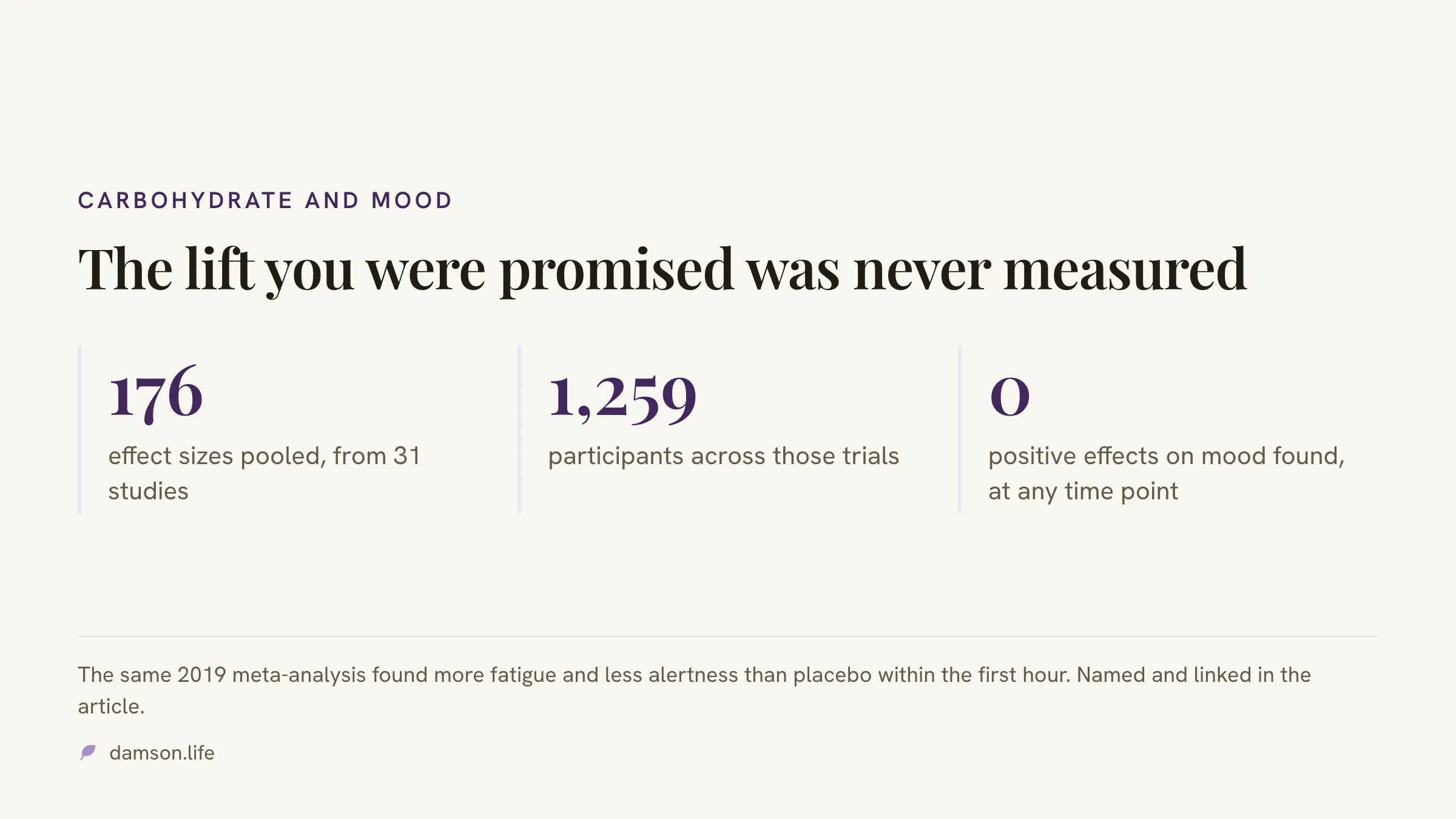
A 2019 meta-analysis pooled 176 effect sizes from 31 studies covering 1,259 participants, looking at what happens to mood after people consume carbohydrate. It found no positive effect on any aspect of mood, at any time point after eating. What it did find was that carbohydrate was associated with higher levels of fatigue and less alertness than placebo within the first hour.
Read that carefully, because it is more interesting than the usual version. There was no lift to lose. If you have noticed that a bread-and-pasta lunch leaves you flat and assumed the flatness followed a lift you had somehow missed, the research says the flatness is the whole of the effect.
Sleep is the variable most often missed
This is the part specific to this condition, and the part most likely to be the actual answer.
A meta-analysis of seventeen studies covering 648 participants, all using proper sleep testing rather than questionnaires, found that 35 per cent of women with this condition had obstructive sleep apnoea, with a confidence interval from 22 to 49 per cent. Compared with control groups, the odds were 3.83 times higher, with a confidence interval from 1.43 to 10.24. Prevalence was substantially higher among participants with obesity, and the authors’ conclusion is aimed at clinicians: have a high index of suspicion.
A wider review of sleep in this condition adds the detail that matters if you do not fit that description. Sleep disturbances and disorders, including obstructive sleep apnoea and excessive daytime sleepiness, occur more frequently in women with this condition than in comparison groups. The associations generally hold after adjusting for body mass index, and sleep problems also occur in women with this condition who are of normal weight. The review describes the pathways as several and possibly bidirectional, involving hormonal features, possible changes in cortisol and melatonin, and psychological factors including anxiety and depression.
There is a simple diagnostic question hiding in all this. If you are tired after eating, are you also tired before eating? A study that interviewed twenty women with this condition found tiredness among the impacts described, raised by eight of them. If the tiredness is there most of the day and the meal simply makes it more noticeable, the meal is the messenger. Persistent daytime sleepiness, waking unrefreshed, or being told that you snore are all reasons to raise sleep with a clinician rather than to keep adjusting your lunch.
What actually holds a meal together
None of that means composition is irrelevant. It means composition works through fullness rather than through tiredness, and fullness is worth having on its own terms.
Two trials are worth knowing. In the first, 36 people were given oatmeal, an equal calorie serving of corn flakes, or water. Fullness was greatest and hunger lowest after the oatmeal, they ate less at the following lunch, and the stomach emptied more slowly after the oatmeal than after the corn flakes. In the second, 48 people took part in a randomised crossover trial comparing instant oatmeal with a ready to eat oat based cereal; the oatmeal produced more fullness, less hunger, less desire to eat and a lower expectation of eating more later, which the authors attributed to viscosity and to the beta-glucan.
Both were short, both were in people without this condition, and both were measuring how people felt rather than how alert they were. What they support is modest: meals differ in how long they hold you, and protein and viscous fibre are the components that most reliably extend it. A lunch that holds you until the evening is a better lunch than one that does not, whatever it does to your three o’clock.
What the evidence does not show
Nobody has studied post-meal tiredness in this condition specifically. We looked. Everything above is either general sleep research, general postprandial research, or research on sleep disorders in this condition that does not connect them to meals.
The 2023 international guideline puts eating and other lifestyle changes at the front of care and is candid that its own evidence base is generally low to moderate quality. It endorses no particular dietary composition. So any page that tells you which lunch will fix your afternoon is telling you something nobody has measured, in a condition where the guideline itself declines to prescribe a way of eating.
Why the real answer is personal
The general findings give you four candidates: the size of the meal, the hour of the day, how you slept, and whether the meal held you at all. They cannot tell you which is yours, because they averaged across people who were not you.
You can find out, and it takes less effort than the internet implies. Note the meal in enough detail to repeat it, roughly how much, and roughly when. Then note how you felt an hour or two later, in your own words rather than as a number. Note last night’s sleep too, in one word, because it is the variable most likely to explain the days that do not fit. After a few weeks the answer usually declares itself, and it is often unglamorous: the same lunch is fine on Tuesday and heavy on Thursday, and the difference was Wednesday night.
That is the loop we built Damson for. It holds the record, it describes the plate in terms of what was on it, and it shows you your own pattern instead of an average. It is on the App Store for iPhone, and a paper notebook does the same job if you would rather not use an app.
Questions people ask
Why does PCOS make me tired after eating? There is no evidence that it does, specifically. What is established is that sleep disorders, including obstructive sleep apnoea and excessive daytime sleepiness, are more common in this condition, and that a large meal worsens sleepiness that is already present. Those two facts together explain a great deal of post-meal tiredness without needing anything unique to the condition.
Is it the carbohydrates? Less than you have been told. The largest analysis of carbohydrate and mood found no positive effect at any time point, and more fatigue and less alertness in the first hour. A separate study comparing high-fat, high-carbohydrate and mixed meals found no difference in how sleepy people became. Portion is the more useful variable.
Should I eat smaller meals more often? It is worth testing and it is not established advice. The one properly controlled comparison of a large and a small lunch found more sleepiness after the large one, in twelve sleep-deprived young men. Split your largest meal in two for a fortnight, note the afternoons, and you will have better evidence about yourself than that study can give you.
When should I talk to a doctor about tiredness? If it is there most of the day rather than only after meals, if you wake unrefreshed, or if anyone has told you that you snore or stop breathing in your sleep. Obstructive sleep apnoea was found in about a third of women with this condition in the studies that tested for it properly, and it is treatable once identified.
The bottom line
Post-meal tiredness is real and its causes are mostly not the ones you have been offered. The afternoon dip is largely a body-clock effect that arrives with or without lunch, a large meal makes an existing sleepiness worse, meal composition made no difference in the study that compared it directly, and carbohydrate produced more fatigue rather than a lift followed by a fall. The variable most worth investigating in this condition is sleep, because sleep disorders are genuinely more common here and they are treatable. Everything else is settled by your own notes, kept for a few unremarkable weeks.
Read next
Short sleep raises appetite as reliably as it raises tiredness, which is the other half of why does PCOS make me so hungry.
If the meal leaves you uncomfortable as well as sleepy, why do I get bloated after eating covers the gut side of the same hour.
And the fullness trials mentioned here are set out properly in is oatmeal good for PCOS.
In Damson, tired is one of the four answers to the meal check-in a few hours after you eat, and the symptom tracker keeps the days fatigue turned up.
Sources
- Reyner LA, Wells SJ, Mortlock V and Horne JA, post-lunch sleepiness during prolonged monotonous driving, effects of meal size, Physiology and Behavior 2012 PMID 22155490
- Orr WC, Shadid G, Harnish MJ and Elsenbruch S, meal composition and its effect on postprandial sleepiness, Physiology and Behavior 1997 PMID 9284488
- Mantantzis K, Schlaghecken F, Sunram-Lea SI and Maylor EA, meta-analysis of the effects of carbohydrate ingestion on mood, alertness and fatigue, Neuroscience and Biobehavioral Reviews 2019 PMID 30951762
- Kahal H and colleagues, the prevalence of obstructive sleep apnoea in women with polycystic ovary syndrome, a systematic review and meta-analysis, Sleep and Breathing 2020 PMID 31111411
- Fernandez RC and colleagues, sleep disturbances in women with polycystic ovary syndrome, prevalence, pathophysiology, impact and management strategies, Nature and Science of Sleep 2018 PMID 29440941
- Martin ML, Halling K, Eek D, Krohe M and Paty J, understanding polycystic ovary syndrome from the patient perspective, a concept elicitation patient interview study, Health and Quality of Life Outcomes 2017 PMID 28821294
- Geliebter A and colleagues, effects of oatmeal and corn flakes cereal breakfasts on satiety and gastric emptying, Annals of Nutrition and Metabolism 2015 PMID 25612907
- Rebello CJ and colleagues, randomised crossover trial of instant oatmeal against a ready-to-eat oat-based breakfast cereal, Journal of the American College of Nutrition 2016 PMID 26273900
- Teede HJ and colleagues, recommendations from the 2023 international evidence-based guideline for the assessment and management of polycystic ovary syndrome, Human Reproduction 2023 PMID 37580037
Damson is on the App Store.
Free to download, and the record is free to keep. No ads, and nothing to cancel later that you did not choose.
Download on the App Store