Can you eat rice with PCOS? White, brown and basmati
Yes, rice fits with PCOS. What separates white rice from brown, where basmati comes in, and why the rest of the plate does more than the grain.
Yes, you can eat rice with PMOS (formerly PCOS). No guideline forbids it, and no trial has shown that one grain decides how the condition goes. What changes things is the type of rice, the portion, what sits beside it on the plate, and how your own afternoon answers.
That is the short version. The longer version is worth reading, because the reason the internet gives you a different answer on every page is that most of those pages are answering a question the research has not asked.
Rice cooked this morning and rice cooked last night are not quite the same food.
What the evidence actually supports
The 2023 international guideline for this condition runs to 254 recommendations and practice points, and it puts eating and other lifestyle changes at the front of care. It is also candid about its own foundations: the evidence behind it is described as generally low to moderate quality. That is not a reason to ignore it. It is a reason to be suspicious of anyone who speaks about a single food with more certainty than the guideline speaks about the whole condition.
On the specific question of what a diet should be made of, the systematic review commissioned to inform the guideline compared diets of different composition and found the improvements happened regardless of composition. No one pattern came out ahead of the others. The trials it gathered were mostly short and small, and none of them was designed to tell you how a bowl of rice sits with you on a Tuesday.
So the honest position is this. There is good reason to care about how you eat. There is no evidence that rice, specifically, is the thing standing in your way.
What is actually in rice
Rice is starch with a little protein and, depending on the type, some fibre. Milling white rice removes the bran, which is where most of the fibre sat. In the USDA reference data, cooked white long grain rice carries well under a gram of fibre per 100 grams, while cooked brown rice keeps roughly one and a half grams. Both are modest. Neither is a fibre food in the way lentils or oats are.
That matters less as a verdict on rice than as a description of what rice does not bring. A plate that is mostly rice is a plate that is mostly starch, low in fibre and low in protein, and it is the absence of those two, rather than the presence of rice, that tends to leave people hungry again sooner than they expected.
There is a practical trick for packaged grain foods, including rice mixes and rice based products. Researchers comparing five ways of identifying better grain products across 545 items found that a simple test, ten grams of carbohydrate or fewer for every gram of fibre, picked out products with more fibre and less sugar than the industry whole grain stamp did. It is a label test you can do in a shop in ten seconds, and it works better than the badge on the front.
Preparation changes the food
This is the part almost no page mentions, and it is the most interesting thing about rice. Cooking rice and then cooling it changes its starch. Some of it recrystallises into resistant starch, which is starch that survives digestion in the small intestine rather than being absorbed there.
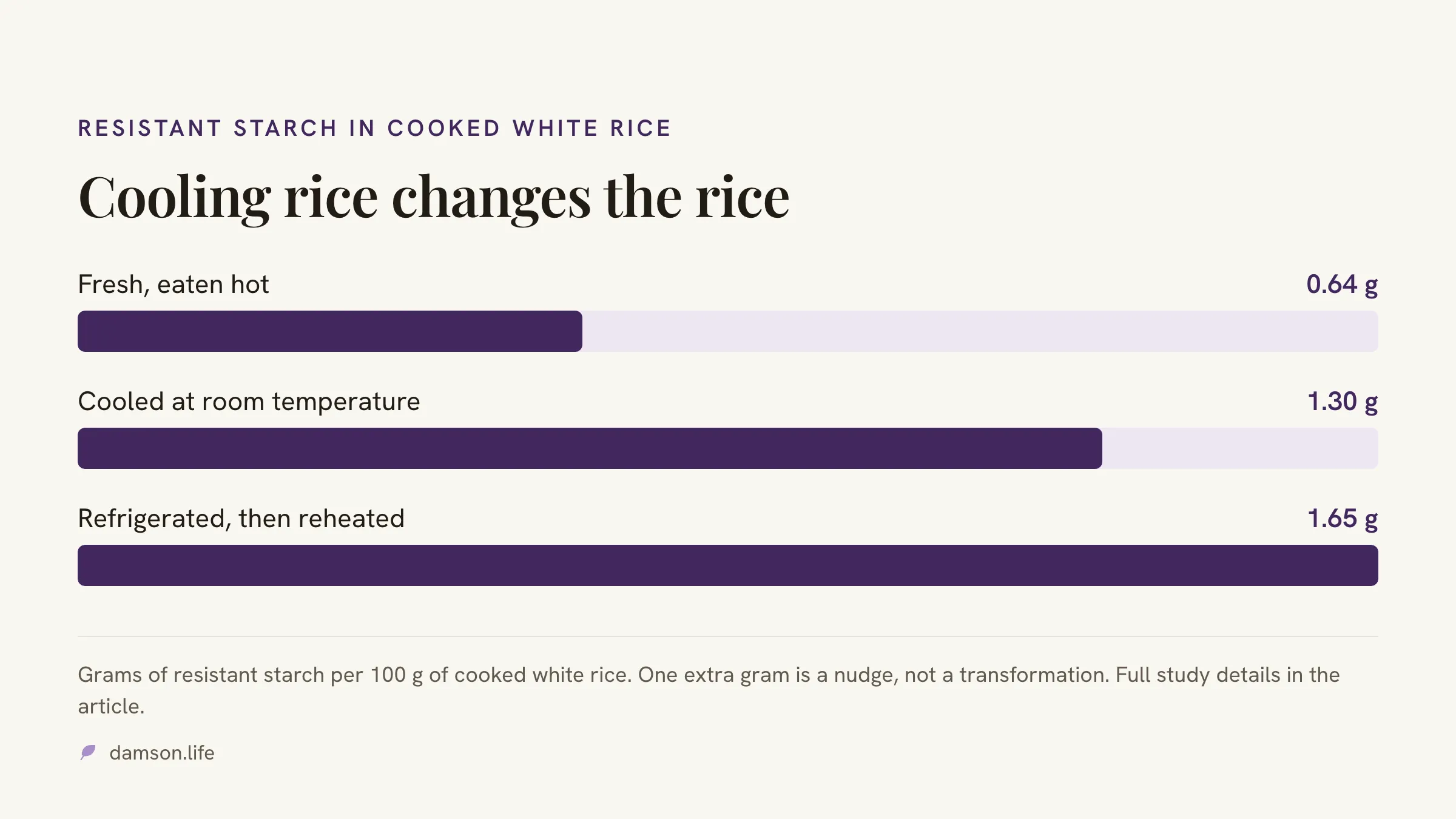
In a study of cooked white rice, fresh rice held 0.64 grams of resistant starch per 100 grams, rice cooled at room temperature held 1.30 grams, and rice refrigerated and then reheated held 1.65 grams. A separate study of five rice varieties stored in the cold found the same direction: colder storage and longer storage produced more resistant starch.
Keep the size of that in proportion. We are talking about roughly one extra gram per 100 grams, so yesterday’s rice is a nudge and not a transformation. But it is a real change in the food itself, made by nothing more expensive than a fridge, and it is a good example of why “is rice good or bad” is the wrong shape of question. Rice cooked this morning and rice cooked last night are not quite the same food.
The rest of the plate does more work than the rice does
If you take one thing from this page, take this. The interesting variable is almost never the rice on its own. It is what the rice arrives with.
Protein and fibre are the two things that most reliably make a meal feel like a meal. They slow the whole business down: a plate with beans, fish, eggs, chicken, tofu, yoghurt or lentils on it empties from the stomach more slowly than the same plate without them, and it tends to hold you for longer. A fat with some substance to it, olive oil, avocado, a spoon of tahini, does something similar. Vegetables add volume and fibre for very little else.
None of this is specific to this condition, and we are not going to pretend it is. It is ordinary composition and ordinary satiety, and it happens to be exactly the part of eating that most people notice within an hour or two, which makes it the part worth paying attention to.
Portion, without arithmetic
Portion matters, and it does not need a calculator. The most useful version of the question is not how many grams, it is what proportion of the plate. A serving of rice next to a good amount of protein and something green is a different meal from a plate of rice with a little something on top, even when the weight of the rice is identical.
If you want a single practical adjustment to try, keep the rice you like, and change what shares the plate with it. That is easier to sustain than switching to a grain you find joyless, and it is more likely to be the thing that was actually missing.
Why the real answer is personal
Everything above is a general statement, and general statements have a ceiling. They can tell you which direction to look. They cannot tell you what basmati at lunch with chickpeas does to your afternoon, because nobody has measured you.
You are, however, in a position to measure yourself, and it takes less effort than the internet suggests. Note the meal in enough detail to repeat it: the rice, roughly how much, and what came with it. Then note how you felt an hour or two later, in your own words rather than as a number. Do that a handful of times across a few weeks and a pattern either appears or it does not. Both outcomes are useful. Either you have learned something specific about your own body, or you have learned that rice is not the variable, and you can stop giving it rent free space in your head.
That is what we built Damson to do: to hold the record, notice the pattern, and explain the plate in terms of what was on it rather than guessing at what happened in your blood. It is on the App Store for iPhone. A notes app and a little consistency will also get you most of the way.
Questions people ask
Is brown rice better than white rice for PCOS? Brown rice brings more fibre, which is a real if modest difference, and no trial has shown it changes the course of the condition. If you prefer brown, that is a reasonable default. If you dislike it, adding fibre and protein to the plate you actually enjoy will do more than switching to a grain you resent.
How much rice can I eat with PCOS? There is no guideline number, and anyone who gives you one is guessing. Judge it by proportion rather than grams: rice as part of a plate rather than the whole of it, alongside protein and something green. Then let your own record tell you whether the amount is right for you.
Does leftover rice really make a difference? It genuinely changes the food, and the change is small. Cooking, cooling and reheating rice raises its resistant starch content by around a gram per 100 grams in the studies that measured it. Treat it as a free nudge rather than a strategy. Reheat it properly, and follow ordinary food safety advice about cooling and storing cooked rice.
What about basmati, jasmine or rice noodles? Rice types genuinely differ from one another, more than most people assume, and the differences do not follow fibre content in a tidy way. Since we cannot tell you which type suits you, the practical move is to pick the one you like, keep it consistent for a few meals, and see what your own notes say.
The bottom line
Rice is not the problem, and it is not the answer. The guideline does not forbid it, the review that informed the guideline found no single dietary composition superior, and the honest general advice is dull: keep the portion in proportion, put protein and fibre beside it, and use the fridge if you happen to have leftovers. Beyond that, the only source that can tell you what rice does for you is your own record, kept for a few unglamorous weeks.
Read next
The same questions apply to the other staple people worry about: is oatmeal good for PCOS.
A plate that is mostly starch tends to leave you hungry sooner, which is the subject of why does PCOS make me so hungry.
Since the answer for you is in your own afternoons, choosing a food diary you will still open in week three is where to start writing them down.
If you want to see how your own rice plates sit, Damson’s food scanner reads a photo of the plate in plain sentences, and a few hours later asks how it went.
Sources
- Teede HJ and colleagues, recommendations from the 2023 international evidence-based guideline for the assessment and management of polycystic ovary syndrome, Human Reproduction 2023 PMID 37580037
- Moran LJ and colleagues, dietary composition in the treatment of polycystic ovary syndrome, a systematic review to inform evidence-based guidelines, Journal of the Academy of Nutrition and Dietetics 2013 PMID 23420000
- Sonia S, Witjaksono F and Ridwan R, cooling of cooked white rice and its resistant starch content, Asia Pacific Journal of Clinical Nutrition 2015 PMID 26693746
- Chakraborty I and colleagues, effect of storage time and temperature on the digestibility of retrograded rice, Gels 2023 PMID 36826312
- Mozaffarian RS and colleagues, identifying whole grain foods, a comparison of different approaches for selecting more healthful whole grain products, Public Health Nutrition 2013 PMID 23286205
- USDA FoodData Central, reference entries for cooked white and brown long-grain rice
Damson is on the App Store.
Free to download, and the record is free to keep. No ads, and nothing to cancel later that you did not choose.
Download on the App Store