What is food noise, and what helps with PCOS?
Food noise is the constant hum of thoughts about food. What researchers mean by it, what is known in PCOS, and the two things that most reliably quieten it.
Food noise is the constant background of thoughts about food that will not switch off. Nobody has measured it in PMOS (formerly PCOS), so treat confident claims with suspicion. The nearest well-studied idea is food cue reactivity.
What can be said is smaller than the internet’s version, and testable on yourself within a fortnight.
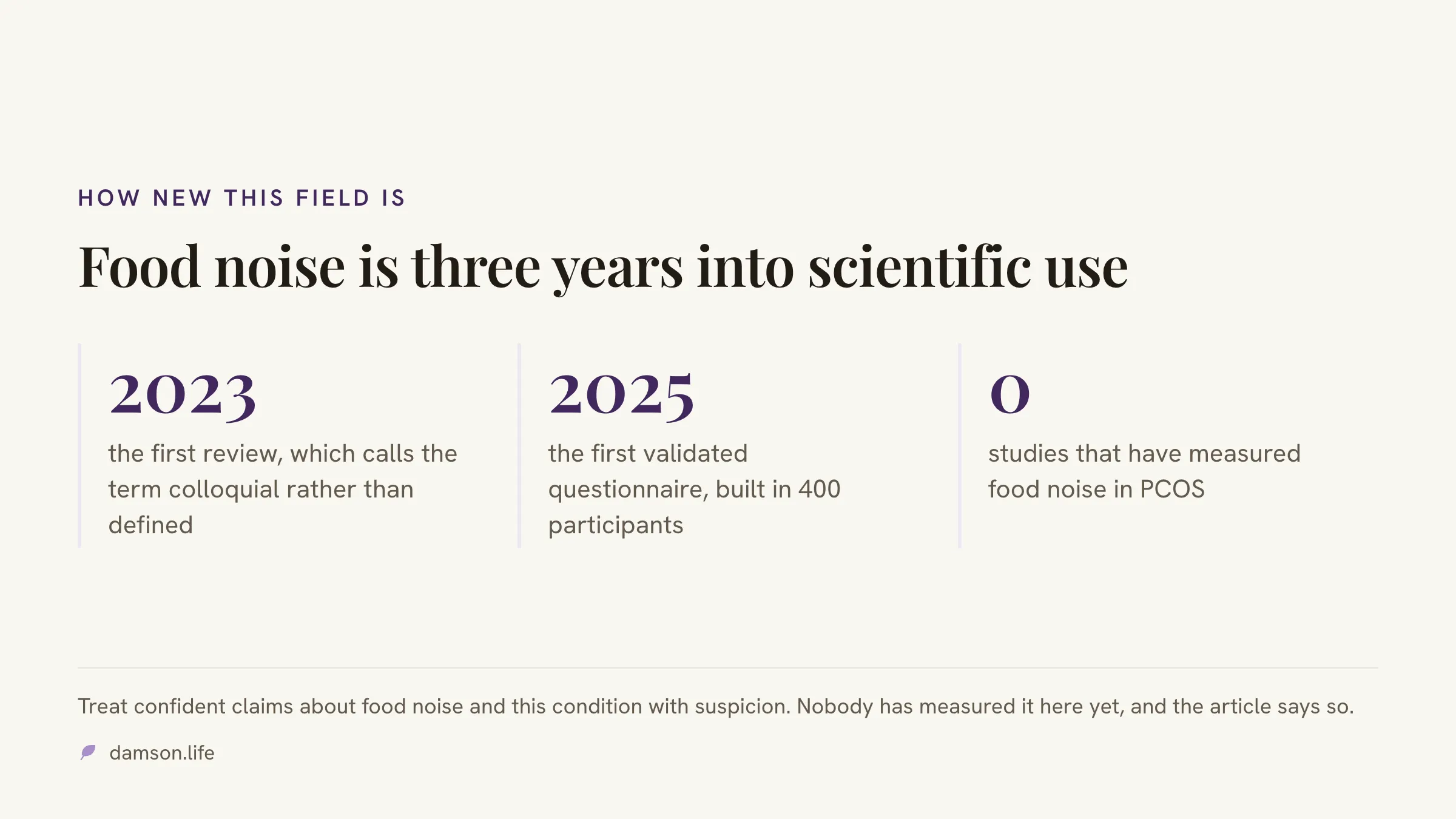
Three years of scientific use, and nobody has measured it in this condition yet.
Where the phrase came from
Food noise arrived in medicine from the outside. It was a word people used about their own experience before it was a word in a journal, and the researchers who first tried to define it said so: a 2023 review in Nutrients describes it as having been “colloquially termed” rather than scientifically defined.
How new this is becomes clear in the measurement. The first questionnaire designed to assess food noise was published in 2025, and its authors open by noting that no validated questionnaire for it existed before theirs. They built a five-item scale in 400 participants and reported good reliability. Their conclusion is appropriately modest: the questionnaire is reliable and valid, and further research is needed to establish whether it is clinically useful.
None of that is a reason to doubt what you are experiencing. It is a reason to be sceptical of anyone who claims to know what causes it.
What the research does have a name for
The review’s contribution is to connect the popular term to work that already existed, under the name food cue reactivity: conditioned responses to food cues. The useful part of that definition is that the cues come from two directions. External cues are the ones you would expect, seeing food, smelling it, walking past it, an advertisement. Internal cues are the ones people forget, including the feeling of your own stomach. Those responses are experienced as food-related thoughts and as cravings, which is a fairly precise description of what people mean by food noise.
It is a narrative review rather than a trial, so treat its model as a way of organising the question rather than an established mechanism. What it usefully establishes is that the volume knob is not only in your head and not only in the food. It sits between a cue and your current state, and your current state is the part you have some influence over.
What is known about this condition
Nothing about food noise. Something important about its neighbourhood.
A 2024 systematic review and meta-analysis gathered twenty studies covering 28,922 women with this condition and 258,619 without. The odds of having any eating disorder were higher, at 1.53 with a confidence interval from 1.29 to 1.82. The odds of binge eating disorder and of bulimia nervosa were both significantly raised. Anorexia nervosa was not. Measures of disordered eating ran higher too, with a standardised mean difference of 0.52, and this held regardless of body weight.
That last clause is the one to hold on to. The raised risk was not confined to any weight category, so it is not a story about size and not something you can rule out about yourself by looking in a mirror.
Two honest readings follow. If food occupies more of your attention than you would like, you are in a group where that is genuinely more common, and you are not being dramatic. And persistent, distressing preoccupation with food, particularly when attached to episodes of eating that feel outside your control, is a reason to talk to someone qualified rather than to reach for a better breakfast. We cannot tell the difference for you, and it is worth taking seriously.
Why avoiding a food can make it louder
A 2020 review in Current Nutrition Reports examined whether dieting causes cravings, and the answer is more nuanced than the version you have heard. Experimental evidence shows that short-term, selective avoidance of a particular food increases cravings for that specific food. But craving behaves as a learned response, which means it can be extinguished, and sustained longer-term calorie restriction in the studies reviewed was associated with fewer cravings rather than more.
Unpick that, because it explains a demoralising experience. Deciding on Monday that bread is off the list is very likely to make you think about bread more this week. That is a documented effect of selective avoidance, not a character flaw and not evidence that you are addicted to bread. If a named food is getting louder rather than quieter, that is the expected result of that manoeuvre, and something other than a shorter list is more likely to help.
The two levers worth pulling
Meals that actually hold you. Internal cues include your own hunger, so a meal that leaves you hungry an hour later has added a cue rather than removed one. The components that most reliably extend fullness are protein and viscous fibre. In a randomised crossover trial, 48 people ate either instant oatmeal or a ready to eat oat based cereal; the oatmeal produced more fullness, less hunger and less desire to eat, which the authors put down to viscosity and to the beta-glucan. Both breakfasts were made of oats. Same grain, different form, different result. If your afternoons are loud, the first thing to look at is whether lunch was mostly starch.
Sleep. This is the lever people skip, and the evidence is stronger than you would guess. A meta-analysis of 41 randomised controlled trials found that restricting sleep increased subjective hunger by 13.4 millimetres on a 100 millimetre scale, and increased what people ate by roughly 253 calories a day. Those are averages from controlled experiments, describing an effect produced by nothing more than a short night. If you have been treating a loud day as a failure of willpower, that is worth sitting with.
Why tracking can make this worse
We build a food app, so this is where we tell on our own industry.
A qualitative study interviewed 24 university women with eating disorder behaviours about their use of diet and fitness apps. The themes were specific: fixation on numbers, rigid eating, obsession, dependency on the app, extreme negative emotions, motivation from negative messages, and competition. Participants named the features responsible. One described seeing protein and fat and carbohydrate instead of a chicken breast. Another described a red number as frightening enough to keep her from school. A third said she would never buy anything without a label, because she could not record it.
Read that alongside the finding that eating disorders are more common in this condition and the conclusion is uncomfortable. For a meaningful number of people the standard food tracking app is not a neutral tool. It is a machine for turning food into numbers, and that is one of the things that makes the noise louder.
We designed Damson against that list on purpose. There are no numbers to hit, no colours that judge a plate, no rewards for consecutive days and no prompts about what you have not recorded. What it holds is what you ate and how you felt afterwards, in your own words. It is on the App Store for iPhone.
What the evidence does not show
Nobody has measured food noise in this condition. We looked. The term is three years into scientific use, the first validated questionnaire is a year old, and no study has applied it to this population. Nor is there a dietary fix on offer: the 2023 international guideline for this condition endorses no particular dietary composition and describes its own evidence base as generally low to moderate quality.
What can be said is that preoccupation with food is real and now measurable, that disordered eating is more common in this condition at every body weight, that selectively banning a food reliably makes you think about it more in the short term, and that short sleep raises hunger in controlled trials. Those four facts are enough to work with.
Why the real answer is personal
Averages describe groups. Your loud days have a pattern, and it is almost certainly local: a particular lunch, a particular hour, a particular kind of night.
Finding it is unremarkable work. Note what you ate in enough detail to repeat it, how you felt afterwards in your own words, whether the noise was loud that day, and last night’s sleep in a single word. Then read it back after three weeks rather than interpreting each day as it happens. The pattern that appears is usually more banal and more actionable than anything an article could have told you.
That loop is what we built Damson to hold. A notebook works too, and a notebook has the advantage of having no opinions.
Questions people ask
Is food noise a real thing? The experience is real and widely reported. As a scientific construct it is very new: described as a colloquial term in 2023, with the first validated questionnaire appearing in 2025. The nearest established concept is food cue reactivity, meaning conditioned responses to internal and external food cues.
Does PCOS cause food noise? Nobody has tested it. What is established is that eating disorders and disordered eating are more common in this condition, with the odds of any eating disorder raised to 1.53, and that this held regardless of body weight. That makes preoccupation with food a plausible companion to the condition, not a demonstrated consequence of it.
Will cutting out sugar or carbs make it quieter? Probably the opposite, at first. Experimental work shows that short-term selective avoidance of a specific food increases cravings for that food. The same review found cravings can be extinguished over time and that sustained restriction was associated with fewer of them, so the picture is not simple. Cutting one named food this week is the version least likely to help.
When should I get help rather than adjust my meals? If the preoccupation is persistent and distressing, if it is attached to episodes of eating that feel outside your control, or if it is shaping your day. Binge eating disorder and bulimia nervosa are both more common in this condition, and both respond to treatment. That is a conversation for a clinician, not a notebook.
The bottom line
Food noise names something real that research has only just begun measuring properly, and nothing has been studied about it in this condition. What is known is still enough to act on: banning a single food tends to make you think about it more, meals built on protein and viscous fibre generate fewer internal cues, and short sleep raises hunger measurably in trials. Disordered eating is more common in this condition at every body weight, which means a loud relationship with food deserves attention rather than discipline. And if a food app makes your food louder, the app is the problem.
Read next
Food noise and physical hunger are different things that arrive together, and the appetite research is in why does PCOS make me so hungry.
The oatmeal trial quoted here is one of two, both set out in is oatmeal good for PCOS.
Loud afternoons and heavy afternoons often turn out to be the same afternoon: why am I so tired after eating.
Food noise is one of the symptoms you can mark in Damson, and over weeks, patterns from your own record show whether it lines up with anything you logged.
Sources
- Hayashi D and colleagues, what is food noise, a conceptual model of food cue reactivity, Nutrients 2023 PMID 38004203
- Diktas HE and colleagues, development and validation of the Food Noise Questionnaire, Obesity 2025 PMID 39828656
- Meule A, the psychology of food cravings, the role of food deprivation, Current Nutrition Reports 2020 PMID 32578025
- Cooney LG and colleagues, increased prevalence of binge eating disorder and bulimia nervosa in women with polycystic ovary syndrome, a systematic review and meta-analysis, Journal of Clinical Endocrinology and Metabolism 2024 PMID 39115340
- Zhu B, Shi C, Park CG, Zhao X and Reutrakul S, effects of sleep restriction on metabolism-related parameters in healthy adults, a comprehensive review and meta-analysis of randomised controlled trials, Sleep Medicine Reviews 2019 PMID 30870662
- Eikey EV, effects of diet and fitness apps on eating disorder behaviours, a qualitative study, BJPsych Open 2021
- Rebello CJ and colleagues, randomised crossover trial of instant oatmeal against a ready-to-eat oat-based breakfast cereal, Journal of the American College of Nutrition 2016 PMID 26273900
- Teede HJ and colleagues, recommendations from the 2023 international evidence-based guideline for the assessment and management of polycystic ovary syndrome, Human Reproduction 2023 PMID 37580037
Damson is on the App Store.
Free to download, and the record is free to keep. No ads, and nothing to cancel later that you did not choose.
Download on the App Store