What to bring to a PCOS appointment: a checklist for a short slot
What to track in the weeks before a PCOS appointment, which questions the 2023 guideline makes worth asking, and how to get the most from ten minutes.
A PCOS appointment goes better when you walk in with dates. Not a feeling that your periods have been all over the place, but the day each one started and the length of the longest gap. Not a sense that you have been more tired, but the weeks it was worst. Most of what a clinician needs to assess PMOS (formerly PCOS) is history, and history is the one thing you can prepare.
This page is a checklist. The first half is what to track in the weeks before you go. The second half is the questions worth asking, drawn from the 2023 international guideline, and a few plain things about getting the most from a short slot. Nothing here needs an app, though Damson, which is ours, is built to do the gathering for you and we say so where it comes up.
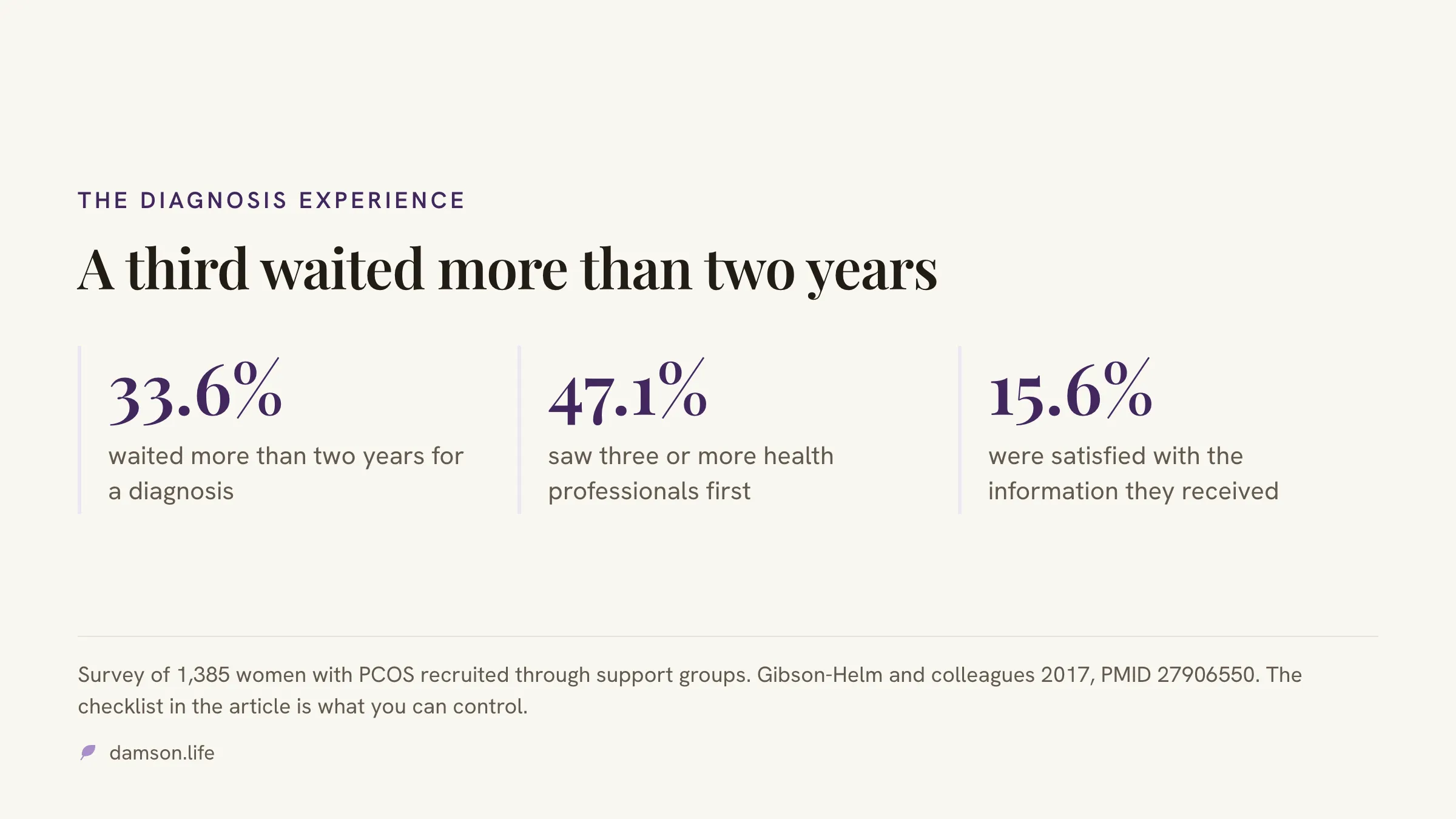
The largest study of the diagnosis experience. A prepared appointment is one of the few parts of this you control.
Why preparation matters more here than for most conditions
In the largest study of how women with this condition were diagnosed, 1,385 women recruited through support groups answered a questionnaire about the experience. A third of them (33.6 per cent) reported waiting more than two years for a diagnosis, nearly half (47.1 per cent) saw three or more health professionals before one was made, and only 15.6 per cent were satisfied with the information they received at the time. Women who had seen five or more professionals, or waited more than two years, were markedly less satisfied with the whole experience.
Those numbers describe a condition that is assessed mostly from history, across several visits, often by someone who is meeting you for the first time. That is exactly the situation where a written record earns its keep.
There is a second reason. A 2019 analysis of 112 recorded consultations found that clinicians asked the patient what they wanted to discuss in only 36 per cent of them, and that when they did ask, they interrupted after a median of eleven seconds. Specialists asked less often than GPs: 20 per cent against 49 per cent. You should not expect to be invited to set the agenda, so bring one.
What to track in the weeks before
You do not need months of data. Four to twelve weeks of honest notes, plus whatever you can reconstruct from before, is a real record. These are the things a clinician can use, in rough order of how much they matter.
Your cycle, including the long gaps
This is the single most useful thing you can bring, because the guideline defines irregular cycles in days. For adults more than three years past their first period, a cycle is irregular when it is shorter than 21 days or longer than 35, or when there are fewer than eight cycles in a year. Any single cycle longer than 90 days counts on its own. The definitions differ for teenagers, and a cycle that runs long in the first year after periods start is considered normal.
So write down the first day of each period, going back as far as you can reliably remember or find in an old app. Note the gaps, especially the long ones. A cycle that ran 52 days is a fact a clinician can act on; “they are pretty irregular” is not. If you are on hormonal contraception, say so and since when, because it changes what the cycle record can show. Damson’s cycle log is built for exactly this, including a month with no period at all.
Symptoms, with dates
Keep it to what you notice, in your own words, with the day. Hair growth where you would rather not have it, hair thinning on your head, acne, bloating, tiredness, low mood, trouble sleeping, snoring if anyone has told you. The guideline asks clinicians to take unwanted hair growth and hair loss seriously regardless of how severe they look, and to screen every adult for depression and anxiety, so these are not things to leave out because they feel minor or unrelated.
A pattern of dates is worth more than a list. “Bloating most evenings for the last three weeks” tells a clinician something that “bloating” does not. A symptom tracker that stamps the day is the easiest way to get there.
Medicines and supplements, with doses and start dates
Everything you take, prescribed or not: the name, the dose as written on the box, how often, and when you started. Include the pill, inositol, vitamin D, anything from a health shop. The guideline specifically encourages women taking inositol and other complementary therapies to tell their healthcare professional, and a 2017 review of supplement and drug interactions notes that most patients do not disclose supplement use unless asked. Bring the list so nobody has to ask. There is a separate page on keeping a supplement and medication log, including how to note a change.
Weight and waist, if you choose
The guideline asks clinicians to seek permission before discussing or measuring weight, and to recognise that weight is one indicator of health among many. Whether you bring these numbers is up to you. If you do, a few readings over several weeks are more useful than one, and a waist measurement is worth including alongside, since the guideline treats central adiposity as its own thing.
Meals and how they sat, if it is relevant to you
If part of what brought you here is what happens after you eat, the bloating, the tiredness, the hunger that returns too soon, then a few weeks of plain meal notes help. What you ate, roughly how much, when, and how you felt a couple of hours later. You are not bringing a diet to be graded. You are bringing evidence of a pattern, or of the absence of one. Damson’s meal check-ins ask the question a few hours after each meal so you do not have to remember.
Family history
Diabetes, heart disease, high blood pressure, and the same condition in a mother or sister. The guideline treats the first-degree relatives of women with this condition as being at raised diabetes risk themselves, and family history shapes how often you are screened.
Past results, and where they are
If you have had bloods, an ultrasound, or a diagnosis letter from anyone, bring copies or at least the dates and the name of the clinic. Ask for anything you do not have. A test repeated because nobody could find the first one is a wasted appointment.
Questions worth asking
These follow the 2023 guideline, which is the reference most clinicians treating this condition now work from. You will not get through all of them in one slot. Pick the three that matter most to you and write them down; question lists that patients bring in have been shown, in a systematic review of sixteen studies, to increase how much patients ask and how much they recall afterwards. The studies were in cancer care, which is not this, but the mechanism is the same: a written question gets asked.
On the diagnosis itself
- Which of the criteria do I meet? The guideline requires two of three: irregular cycles, signs or blood evidence of raised androgens, and polycystic ovaries on ultrasound. Since 2023, a blood test for anti-Müllerian hormone can replace the ultrasound in adults. If you have irregular cycles and raised androgens, you do not need either.
- Which tests have I had, and which do I still need? Total and free testosterone are the tests the guideline names first for the blood side. Ask which assay was used if the result was borderline, because the guideline is particular about this.
- Has anything else been ruled out? The guideline requires exclusion of other causes before a diagnosis is made.
On what gets checked beyond the diagnosis
- Have my blood sugar and lipids been tested? The guideline says every woman with this condition should have her glucose status assessed at diagnosis and every one to three years after, with the 75-gram oral glucose tolerance test as the most accurate option regardless of weight, and should have a lipid profile at diagnosis regardless of age or weight.
- When was my blood pressure last taken? The guideline asks for it annually.
- Should I be assessed for sleep apnoea? If you snore and wake unrefreshed, or are sleepy in the day, the guideline says you should be asked about it and screened or referred. This applies at any weight.
- Can we talk about mood? The guideline asks for every adult to be screened for depression and anxiety. If nobody has asked, you can raise it.
On treatment
- What are my options, and what does each one actually do? The guideline is clear that lifestyle change and medicines such as metformin have similar effects on the metabolic side, that gut side effects from metformin are usually mild, dose-related and settle, and that no particular type or dose of inositol can currently be recommended. It is reasonable to ask which of your own concerns a given treatment is meant to address.
- What should I track between now and next time? This is the question that makes the next appointment better than this one.
If pregnancy is on your mind, the guideline has a section on it, and that is a conversation to have with the clinician directly rather than with a website.
This page is not medical advice, and nothing on it replaces the judgement of the person who can examine you and see your results. Its job is to make that conversation more useful.
Getting the most from a short appointment
Say your main concern in the first sentence. Not the background, the concern: “my periods have gone to 50-day gaps and I want to know what to do about it.” The analysis of recorded consultations above found that patients who were allowed to finish took a median of six seconds to state their agenda, so this is not a long speech. It is one line, and it sets the direction of everything that follows.
Hand over the record rather than reciting it. A page with the cycle dates, the symptom dates and the medicine list can be read in thirty seconds, which is faster than you can say it and more accurate than memory under pressure.
Keep the three questions visible and tick them off. If time runs out, ask which of the remaining ones can be answered by message, or booked for next time.
Before you leave, ask what happens next: which tests, who contacts whom, and when. Write that down too.
Damson, which we make, does the gathering part. Its appointment page takes your cycle record, your symptoms with their dates, your meals and check-ins if you want them, your medicines with doses and start dates, your weight and waist if you note them, and the questions you wrote beforehand, and puts them on one page for the period you choose, with the guideline referenced. It is part of the free record, and it never leaves your phone unless you share it. A notebook does the same job for anyone who would rather not use an app.
Questions people ask
What should I bring to a PCOS appointment? The first day of each period as far back as you can, including the longest gaps; symptoms with the dates they happened; every medicine and supplement with its dose and start date; your family history of diabetes and heart disease; and any past results or the clinics that hold them. Weight and waist are optional and yours to decide. Three written questions, in order of importance, are the last thing on the list and often the most useful.
What questions should I ask my doctor about PCOS? Which diagnostic criteria you meet and which tests you have had; whether your blood sugar, lipids and blood pressure have been checked, since the 2023 guideline asks for all three; whether sleep apnoea or mood should be looked at; what each treatment option is meant to do for you; and what to track before the next visit.
How do I prepare for a PCOS appointment if my periods are irregular? Write down what you can reconstruct, even if it is patchy, and start recording from today. The guideline counts a cycle as irregular at under 21 or over 35 days, or fewer than eight a year, and any single cycle over 90 days on its own, so dates are the point. A log that handles months with no period is easier than a calendar app that assumes 28 days.
How long should I keep a symptom diary before seeing the doctor? Four to twelve weeks is enough to show a pattern, and more is not required. If the appointment is sooner than that, bring what you have; a fortnight of dated notes is still better than memory, and the record keeps growing for next time.
Do I need to tell my doctor about supplements? Yes. The 2023 guideline specifically encourages women taking inositol and other complementary therapies to tell their healthcare professional, and most people do not mention supplements unless asked. Bring the list with doses so the question does not depend on being asked.
The bottom line
The condition is diagnosed and managed mostly from history, and a third of women waited more than two years to get there. What you can control is the history: cycle dates with the long gaps, symptoms with dates, a complete medicine and supplement list, family history, and past results. Add three written questions grounded in the guideline, say your main concern in the first sentence, and ask what happens next before you leave.
Read next
The medicine and supplement list is worth its own page: keeping a PCOS supplement and medication log covers doses, start dates, side effects and how to note a change.
If the name on your letter has changed, PMOS, formerly PCOS explains what the rename did and did not alter.
In Damson, the cycle log, the symptom tracker and the appointment page are the three parts of the app this checklist leans on.
Sources
- Gibson-Helm M, Teede H, Dunaif A and Dokras A, delayed diagnosis and a lack of information associated with dissatisfaction in women with polycystic ovary syndrome, Journal of Clinical Endocrinology and Metabolism 2017 PMID 27906550
- Singh Ospina N and colleagues, eliciting the patient's agenda, secondary analysis of recorded clinical encounters, Journal of General Internal Medicine 2019 PMID 29968051
- Brandes K, Linn AJ, Butow PN and van Weert JC, the characteristics and effectiveness of question prompt list interventions in oncology, a systematic review, Psycho-Oncology 2015 PMID 25082386
- Teede HJ and colleagues, recommendations from the 2023 international evidence-based guideline for the assessment and management of polycystic ovary syndrome, Human Reproduction 2023 PMID 37580037
- Asher GN, Corbett AH and Hawke RL, common herbal dietary supplement-drug interactions, American Family Physician 2017 PMID 28762712
Damson is on the App Store.
Free to download, and the record is free to keep. No ads, and nothing to cancel later that you did not choose.