Keeping a PCOS supplement and medication log: what to write down
A medication and supplement log for PCOS: doses, start dates, side effects and changes, what inositol and berberine reviews actually show, and how to use it with a clinician.
A medication and supplement log gives you the one thing memory cannot: what you were taking, at what dose, on the day something changed. With PMOS (formerly PCOS), the morning handful is often a mix of a prescription, one or two supplements and sometimes the pill, started at different times on different people’s advice. When a side effect turns up, or a cycle shifts, or a clinician asks what you are on, the log is what turns a guess into an answer.
This page covers why a log helps, what to write down, how to note a change so it stays useful, and what the research actually shows for the three names that come up most, metformin, inositol and berberine. It recommends nothing. One line, said once and meant: do not start, stop or change a prescribed medicine without the person who prescribed it, and tell them about anything else you take.
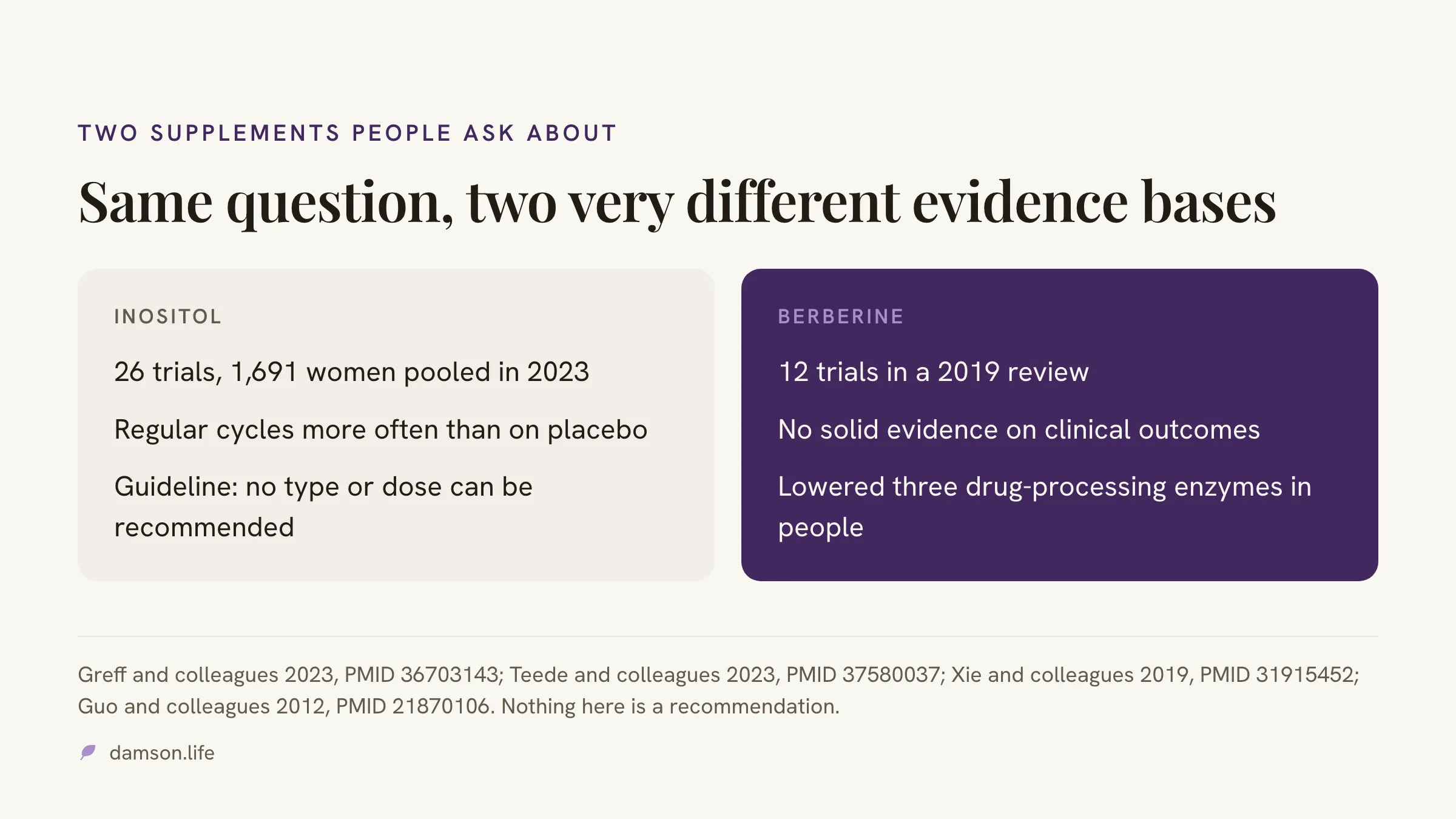
Two supplements people name most, and the shape of the evidence behind each. A log is how you find out what either does for you.
Why keep one
Because most people are taking something, and most do not say so. In a survey of 493 Australian women with this condition, over 70 per cent reported using complementary medicine, usually nutritional and herbal supplements, and 12.2 per cent reported an adverse reaction. A 2017 review of supplement and drug interactions observes that most patients do not disclose supplement use to clinicians at all. The 2023 international guideline specifically encourages women taking inositol and other complementary therapies to tell their healthcare professional. A log makes that disclosure a matter of handing over a page.
Because side effects have dates. The best known side effects of metformin are in the gut. In the meta-analysis of randomised trials done to inform the guideline, mild gastrointestinal effects were considerably more common on metformin than on placebo, with an odds ratio of 7.67. The guideline describes them as generally dose-dependent and self-limiting, suggests starting low and raising the dose in 500 mg steps every one to two weeks, and notes that extended-release forms may help. All of that is about timing: when the dose went up, when the stomach complained, whether it settled. Without dates, “metformin upsets my stomach” cannot be separated from “the last dose increase upset my stomach for ten days and then stopped.”
Because changes are what you are looking for. If you started inositol in March and your cycles shortened in May, that is worth knowing, and it is worth knowing just as much if they did not. A log that records start dates beside the cycle record is the only way to see either.
Because the clinician will ask. Every appointment begins with what you are taking. The appointment checklist puts the medicine list near the top for that reason.
What to write down
For each thing you take, prescribed or not:
- The name, as it appears on the box, including the brand if the product is a supplement, since the guideline notes that the regulatory status and quality control of supplements differ from those of medicines and that doses and quality can vary between products.
- The dose, as written. For a supplement, the amount per capsule and how many you take.
- How often, and at what time of day. Morning and evening doses are two entries, not one.
- The start date. If you cannot remember, your best guess, marked as a guess.
- Who suggested it. A prescriber, a pharmacist, a friend, a video. This matters later when you are deciding what to keep.
- What it is for, in your own words. “Cycles” or “hair” or “I am not sure” are all honest answers, and the last one is useful.
Then, as days pass:
- Whether you took it. Not every dose needs a tick, but missed days matter, particularly in the week before a blood test.
- Anything you noticed, with the date: stomach upset, headache, a change in appetite or mood, a change in sleep. Write what happened rather than what you think caused it.
- Changes, which get their own section below.
Keep it beside your cycle and symptom notes rather than in a separate place. A dose change on the same page as the cycle dates is readable; the same two facts in two apps are not.
How to note a change
Changes are where logs quietly fail, because the old entry gets overwritten and the history vanishes. Treat every change as a new line.
- A dose change: keep the old entry with an end date and add a new one with the new dose and its start date. “Metformin 500 mg, 2 March to 16 March. Metformin 1000 mg from 17 March.”
- A stop: add the end date and, in a few words, why. “Stopped 4 June, stomach, agreed with GP.” Keep the entry.
- A switch of brand or form, for example to an extended-release preparation, is a change. Note it, because the guideline treats the form as something that can alter side effects.
- A new supplement started on the same week as a dose change is a problem for later reading, because you will not be able to tell which did what. Where you have the choice, change one thing at a time and give it a few weeks.
The rule is that the log should let you answer, for any date in the past six months, “what was she taking that day?” If it can, it is doing its job.
What the evidence shows for the names people ask about
These are the three that come up most. The summaries are from the reviews and the guideline, and they are deliberately plain about what has and has not been shown.
Metformin is a prescribed medicine, and the guideline is the clearest source on it. For adults with a BMI of 25 or more it says metformin alone should be considered for metabolic outcomes including insulin resistance, glucose and lipids; for those under 25 it may be considered, with limited evidence. The guideline also says women should be told that metformin and an active lifestyle intervention have similar effects. The trials pooled for the guideline found a modest reduction in BMI and in a marker of insulin resistance compared with placebo, with moderate certainty, and the gut side effects above.
Inositol has more trials behind it than most supplements and less certainty than its marketing suggests. A 2023 meta-analysis pooled 26 randomised trials covering 1,691 women. Compared with placebo, women taking inositol were 1.79 times as likely to have a regular cycle, with a confidence interval of 1.13 to 2.85, and the authors found it non-inferior to metformin on most outcomes. A 2025 meta-analysis of six trials in 388 women found that adding inositol to metformin was associated with more regular cycles than metformin alone, and with small differences in two other measures, while BMI, fasting glucose and insulin resistance did not differ; its authors say further studies are needed to clarify the true benefit. The guideline’s own reading, published the same year as the first review, is more reserved: inositol could be considered based on individual preference, noting limited harm and a possible improvement in metabolic measures but limited clinical benefit for hair growth or weight, and specific types, doses or combinations cannot currently be recommended because the evidence is not good enough. It rates metformin above inositol for hair growth and central adiposity, while noting that metformin has more gut side effects.
Berberine has fewer and smaller trials, mostly from China, and the reviews are candid. A 2019 systematic review found twelve randomised trials and concluded there was no solid evidence that berberine improves clinical outcomes in this condition, though it looked at least as good as metformin on some blood measures. A 2018 review of nine trials found no significant difference between berberine and metformin on insulin resistance and said there were insufficient data to draw conclusions. The guideline does not make a recommendation on it. The safety point is specific and worth knowing: in a two-week human study of 300 mg three times a day, berberine reduced the activity of three enzymes the body uses to process many common medicines, raising the levels of a test drug by around 40 per cent. The authors concluded that drug interactions should be considered whenever berberine is taken. If berberine is in your log, it belongs on the page you hand to the prescriber.
What none of this tells you is what any of them does for you. Three hundred and eighty-eight women in a meta-analysis are an average; your log is a record of one person, and over a few months it is the better guide to your own case, which is why it is worth keeping even when the research is thin.
Where Damson comes in
Damson is ours, an iPhone app for this condition, and medicines and supplements are part of its free record. You add each one with its name, dose, kind and schedule, set a reminder for the times you choose, and mark each dose Taken or Skip from the notification. When something stops, Mark as stopped keeps its history with an end date rather than deleting it. Each medicine’s page has a place to note what you noticed, with the date, kept beside the medicine it followed. The whole record, with doses, start dates, how many scheduled days each was taken on and what you noticed, goes on the appointment page if you include it. The record stays on your phone and your own iCloud, and the app never tells you what to take.
A notebook or a notes app does the same job if you keep the dates. The format matters less than the habit.
Questions people ask
What should a PCOS supplement log include? For each item: the name and brand as on the box, the dose, how often and when, the start date, who suggested it and what it is for. Then, over time, missed doses, anything you noticed with its date, and every change as a new line with its own date. Keep it beside your cycle and symptom record so the dates can be read together.
How do I track inositol? The same way as anything else: the product and the amount per dose, the number of doses a day, the start date, and the cycle record alongside it, since cycle regularity is the outcome the trials measured. The 2023 guideline says no specific type, dose or combination of inositol can currently be recommended, so note exactly which product you take rather than just the word inositol.
Can I take inositol and metformin together? That is a question for your prescriber, not a website. For what it is worth to the conversation, a 2025 meta-analysis of six trials in 388 women compared the combination with metformin alone and found more regular cycles with the combination, and no difference in BMI, fasting glucose or insulin resistance. The guideline encourages you to tell your healthcare professional about any supplement you take alongside a prescription.
Is berberine safe to take with medication? Not without checking. A human study found that two weeks of berberine at 300 mg three times a day reduced the activity of three enzymes that process many medicines, and its authors said drug interactions should be considered. The reviews of berberine in this condition also found no solid evidence of clinical benefit. If it is on your list, show the list to whoever prescribes for you.
What if I forget whether I took a dose? Write “unsure” with the date rather than guessing either way, and do not double up to make up for it. A reminder with Taken and Skip on it removes most of this problem, which is the practical reason Damson has one.
The bottom line
Most people with this condition take something, few say so, and the useful facts about every medicine and supplement are the ones memory loses first: the dose, the start date and the day something changed. Write each one down as on the box, log changes as new lines with dates, note what you noticed when you noticed it, and keep the lot beside your cycle record. The evidence for inositol is real and the guideline still declines to recommend a type or dose; the evidence for berberine is thin and it interacts with common medicines. Your own log, kept for a few months, is the better guide to what any of them does for you, and it is the page a prescriber most wants to see.
Read next
The log is one line on a longer list: what to bring to a PCOS appointment covers the rest, and the questions the guideline makes worth asking.
If the stomach side of metformin is part of your story, does PCOS cause bloating has the trial figures and the guideline’s advice on dose.
In Damson, medicine reminders hold the log, and the appointment page carries it to the clinic.
Sources
- Arentz S, Smith CA, Abbott JA and Bensoussan A, a survey of the use of complementary medicine by a self-selected community group of Australian women with polycystic ovary syndrome, BMC Complementary and Alternative Medicine 2014 PMID 25481654
- Teede HJ and colleagues, recommendations from the 2023 international evidence-based guideline for the assessment and management of polycystic ovary syndrome, Human Reproduction 2023 PMID 37580037
- Melin J and colleagues, the impact of metformin with or without lifestyle modification versus placebo on polycystic ovary syndrome, a systematic review and meta-analysis of randomized controlled trials, European Journal of Endocrinology 2023 PMID 37536294
- Greff D and colleagues, inositol is an effective and safe treatment in polycystic ovary syndrome, a systematic review and meta-analysis of randomized controlled trials, Reproductive Biology and Endocrinology 2023 PMID 36703143
- Kelly FA, de Oliveira Macena Lôbo A, Cardoso JHCO and de Moraes FCA, comparison of metformin with inositol versus metformin alone in women with polycystic ovary syndrome, a systematic review and meta-analysis of randomized controlled trials, Endocrine 2025 PMID 39331347
- Xie L and colleagues, the effect of berberine on reproduction and metabolism in women with polycystic ovary syndrome, a systematic review and meta-analysis of randomized control trials, Evidence-Based Complementary and Alternative Medicine 2019 PMID 31915452
- Li MF, Zhou XM and Li XL, the effect of berberine on polycystic ovary syndrome patients with insulin resistance, a meta-analysis and systematic review, Evidence-Based Complementary and Alternative Medicine 2018 PMID 30538756
- Guo Y, Chen Y, Tan ZR, Klaassen CD and Zhou HH, repeated administration of berberine inhibits cytochromes P450 in humans, European Journal of Clinical Pharmacology 2012 PMID 21870106
- Asher GN, Corbett AH and Hawke RL, common herbal dietary supplement-drug interactions, American Family Physician 2017 PMID 28762712
Damson is on the App Store.
Free to download, and the record is free to keep. No ads, and nothing to cancel later that you did not choose.