Period tracker for irregular periods with PCOS: why apps give up, and what to record instead
Prediction apps break on 40 to 90 day cycles: dates that never come and a late flag every month. What the data says about PCOS cycle length, what is worth recording, and what your clinician uses.
If your period app has given up on you, the fault is in the app, not in your cycle. Most period trackers are prediction machines: they take your average cycle length, add it to your last start date, and draw a circle on the calendar. With PMOS (formerly PCOS), where a cycle can run 40, 60 or 90 days and the next one may be nothing like the last, that circle is wrong most months, and the app responds the only way it knows how: a “late” flag, a nagging notification, and sometimes an assumption that you forgot to log.
What you actually need from a tracker is different and simpler. You need the record of what happened, kept in a form a clinician can use, including the months when nothing happened at all. This page explains why prediction breaks, what is worth writing down, what your doctor does with it, and how to choose an app that will not give up.
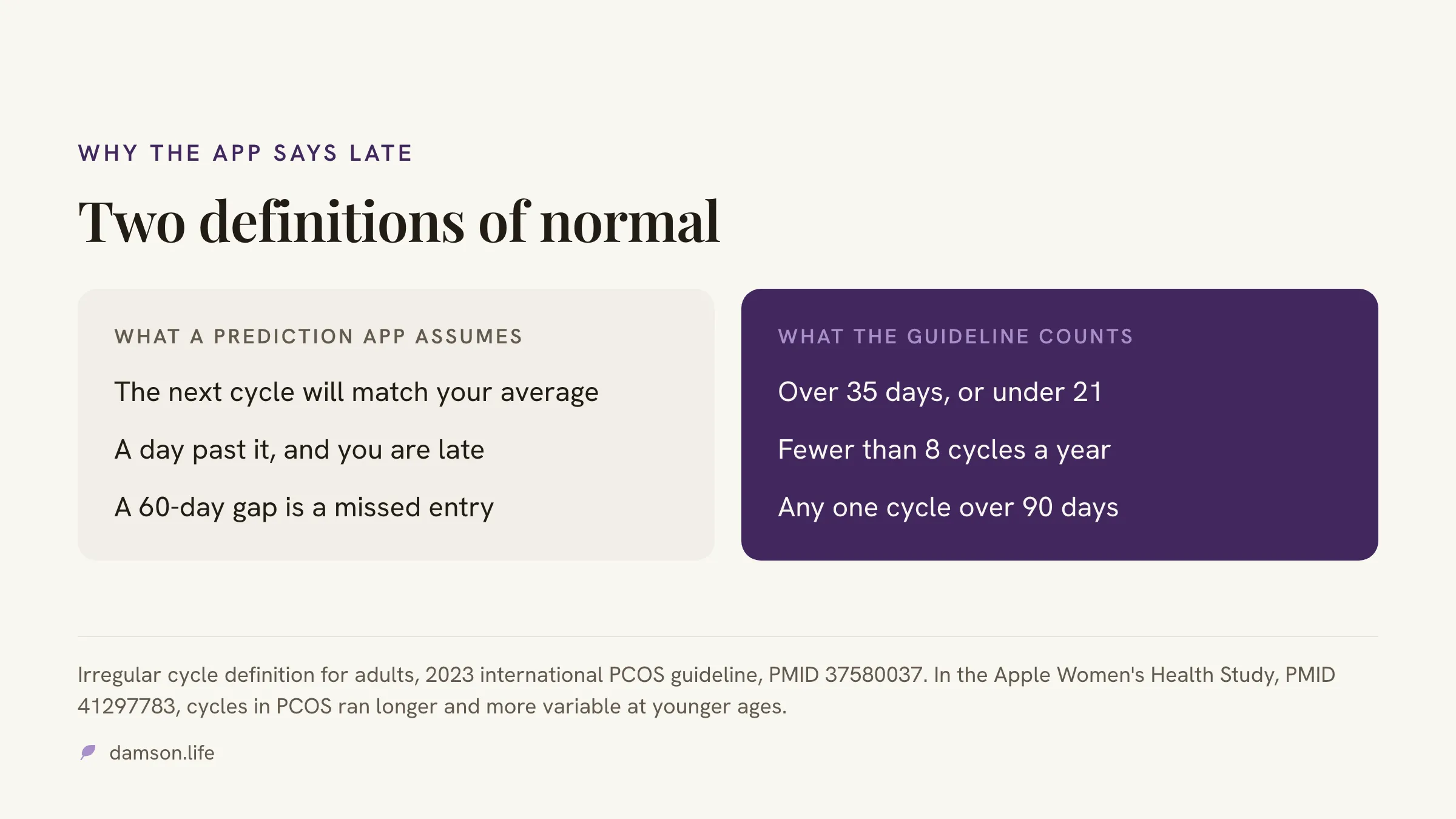
The app and the guideline are working from different definitions of normal.
Why prediction breaks on long and variable cycles
Prediction works when a cycle is both regular and close to the average the app was built around. For most of its users it is. In a database of more than 600,000 cycles logged through one app, the mean cycle length was 29.3 days, 65 per cent of cycles fell between 25 and 30 days, and the typical woman’s cycles varied by only 2.6 days from one to the next. A countdown built on those numbers is right often enough to feel clever.
Cycles in this condition sit outside that comfortable middle in both ways at once. The Apple Women’s Health Study analysed 160,206 cycles from 15,586 people, including 18,875 cycles from 1,842 participants who reported a diagnosis of polycystic ovary syndrome. At younger ages, participants with the condition had cycles that were both longer and more variable than those of participants with regular cycles, with the gap narrowing through the thirties and forties. The researchers measured irregularity as each person’s own standard deviation in cycle length, which is exactly the number a prediction depends on being small.
Put those two findings together and the failure is obvious. An average of 55 days tells the app very little when the cycles behind it were 38, 71, 44 and 67. Whatever date it draws, the real one lands weeks either side. The app then does what it was designed to do with a miss: it marks you late, and it keeps marking you late, because it has no concept of a cycle that is simply still going.
Researchers who studied how women use these apps saw this directly. Across 2,000 app reviews, a survey of 687 people and twelve interviews, they found that apps and calendars help only while their predictions are accurate, and that the modelling fails for people whose cycles are not regular. One reviewer put it exactly: when her cycles ran long, the app assumed she must have forgotten to log. The authors’ suggestion to app designers was to show probabilities rather than confident dates, and to let users record when a prediction missed. Few apps have taken it.
One more finding is useful here. A study of 4.9 million cycles from over 378,000 users found that each person’s cycle length statistics, including how variable they were, stayed stable over the time they used the app. Your irregularity is not noise to be averaged away. It is a consistent fact about you, and it belongs in the record rather than in the error bars.
What is actually worth recording
Once you stop asking an app to guess, the list of things worth writing down gets shorter and more useful.
The days you bled. Not the predicted start, the real one, and the days it ran. Those dates are the backbone of everything a clinician will later count: cycle lengths, cycles per year, the longest gap.
Spotting, separately. Light bleeding between periods is worth noting on its own, with its own label, because it answers a different question from a period and because it can otherwise get counted as one, which shortens your apparent cycles and hides the real pattern.
The month with no period. This is the entry most apps cannot take and the one your clinician most wants. If a month passes without bleeding, that absence is data. Write it down as a fact about the month rather than leaving a blank that could mean anything, and the gap becomes a number, 60 days, 85 days, 120 days, rather than a shrug.
Symptoms, by day. Cramps, pain, bloating, breast tenderness, mood, skin, sleep. Logged against the date, these let you and your clinician see which symptoms cluster near bleeding and which turn up anyway, and they are the record that a long cycle is still a cycle with things happening in it.
What you are taking. If you start, stop or change a contraceptive or any other medicine, note the date. Cycles before and after a change are not comparable, and the date of the change is the detail most often lost by the time of an appointment.
You will notice what is not on the list: a predicted date. Nothing you record needs one.
What a clinician uses from that record
The 2023 international guideline sets out what counts as an irregular cycle, and every threshold in it is a count taken from a record of real dates, which is why the record matters more than the prediction.
For adults, meaning more than three years past a first period and before perimenopause, a cycle is irregular if it is shorter than 21 days or longer than 35, or if there are fewer than eight cycles in a year. From one year after a first period, any single cycle longer than 90 days counts on its own. Between one and three years after a first period the limits are wider, under 21 or over 45 days, because cycles are still settling, and in the first year irregularity is considered a normal part of puberty rather than a sign of anything. The guideline then says that where irregular cycles are present, a diagnosis of this condition should be considered and assessed.
Look at what those numbers need: start dates, so cycle lengths can be counted; a year of them, so cycles per year can be counted; and a note of the longest gap. A record of bleeding days and months without bleeding answers all three directly. A record that consists of an app’s predictions and a string of late flags answers none of them.
That is also the record worth bringing to the appointment. Dates and counts rather than “they are all over the place” turn a vague conversation into a specific one, and they are what makes a change over months visible, whether that change is from treatment, from age, or from nothing in particular. Damson’s appointment page is built to put that record, cycle dates, symptoms and the months without a period, on one page for exactly this reason.
How to choose an app that will not give up
Any app will do for the first week. The test is the third month, when a cycle has run past 50 days. Ask five questions before you commit.
Can it log a period without predicting the next one? If every logged period produces a countdown, you will be told you are late every month. Look for an app that keeps the history and lets you turn prediction off, or that never predicted in the first place.
Can it hold a long gap without complaint? Try it: log a start date, then imagine 70 days with nothing. Does the app flag an error, a late period, a missed entry, or does it simply show that the cycle is on day 70? Only the last is useful.
Can it record a month with no period as a deliberate entry? An empty calendar and a logged absence look the same on screen and mean opposite things in a record. The app should let you say which it was.
Does spotting have its own label? If the only option is to mark a bleeding day, spotting will be counted as periods and your cycle lengths will be wrong.
Can you get the record out? A summary you can show a clinician, on screen or on paper, with dates and counts, is the whole point. If the data lives only inside the app’s own calendar, it is not a record.
Damson is ours, so take this with that in mind, but the cycle log was built around exactly these questions: it logs the days a period ran, keeps spotting separate, has its own button for a month without a period, counts your cycle day without ever predicting the next date, and puts the lot on one page for your doctor. Cycle logging is free. A paper diary does the same job if you would rather not use an app, as long as you write the empty months in too.
Questions people ask
Why does my period app keep saying I am late? Because it predicted a date from your average cycle length and the real cycle is longer. In this condition cycles are longer and more variable than the averages apps are built on, so the prediction misses in most months. The flag describes the app’s guess, not your body.
What is a normal cycle length with PCOS? There is no single number. The 2023 guideline counts an adult cycle as irregular if it is over 35 days or under 21, if there are fewer than eight cycles a year, or if any one cycle runs past 90 days. Many people with the condition sit well outside those limits, and the large cohort studies show the gap tends to narrow with age.
How do I track a month with no period? Record it as an entry rather than leaving the month blank, so the gap becomes a number. Damson has a button for it; in a paper diary, write the month and the word none. Your clinician wants the length of the gap, and a blank cannot give it.
Should I log spotting as a period? No. Log it as spotting. Counting spotting as a period shortens your apparent cycles and hides the pattern your clinician is looking for.
Is there a period tracker for irregular periods with PCOS? Yes. Look for one that keeps the history without predicting, holds a long gap without flagging it, lets you log a month with no period, keeps spotting separate, and gives you a summary to take to an appointment. Damson’s cycle log does those five things, and so can a paper diary.
The bottom line
A period app that gives up on you has not found anything wrong with you. It has found the limit of prediction, and in this condition that limit is reached most months. The record that helps, the days you bled, the spotting kept apart, the months with nothing, the symptoms by date, needs no prediction at all, and it is the record the guideline’s own definitions are built to be counted from. Keep that, in whatever app or notebook will hold it without complaint, and the next appointment starts from dates instead of from memory.
Read next
The condition’s name is changing and the diagnosis is not: PCOS is now also called PMOS explains what the rename does and does not touch.
If you are moving on from an app that gave up, how to leave one PCOS tracker and choose the next covers getting your record out.
The record works the same way for meals as for cycles: why do I get bloated after eating is the clearest example of a question only your own notes can answer.
Damson’s irregular cycle tracker keeps the dates as they happened, and the appointment page puts them on one page for your doctor.
Sources
- Teede HJ and colleagues, recommendations from the 2023 international evidence-based guideline for the assessment and management of polycystic ovary syndrome, Human Reproduction 2023 PMID 37580037
- Mortimer R and colleagues, variability of menstrual cycles by age, polycystic ovary syndrome, and early-life cycle irregularity in the Apple Women's Health Study, American Journal of Obstetrics and Gynecology 2026 PMID 41297783
- Bull JR and colleagues, real-world menstrual cycle characteristics of more than 600,000 menstrual cycles, NPJ Digital Medicine 2019 PMID 31482137
- Li K and colleagues, characterizing physiological and symptomatic variation in menstrual cycles using self-tracked mobile-health data, NPJ Digital Medicine 2020 PMID 32509976
- Epstein DA and colleagues, examining menstrual tracking to inform the design of personal informatics tools, Proceedings of the CHI Conference on Human Factors in Computing Systems 2017 PMID 28516176
Damson is on the App Store.
Free to download, and the record is free to keep. No ads, and nothing to cancel later that you did not choose.