Are eggs good for PCOS? What the trials actually measured
Eggs fit with PCOS. An egg breakfast held people longer than a bagel in trials, the cholesterol worry has been tested in large cohorts, and the rest of the plate still decides the morning.
Yes, you can eat eggs with PMOS (formerly PCOS). No guideline limits them, and no trial has shown that eggs do anything to the condition itself, in either direction. What the trials did measure is how long an egg breakfast holds people compared with a bread one, and whether eating eggs most days moves cholesterol. Both of those are worth knowing, and both are narrower than the internet makes them.
That is the short version. The longer version matters because eggs collect two opposite worries, that they are the fix and that they are a risk to the heart, and the research answers both more calmly than either camp does.
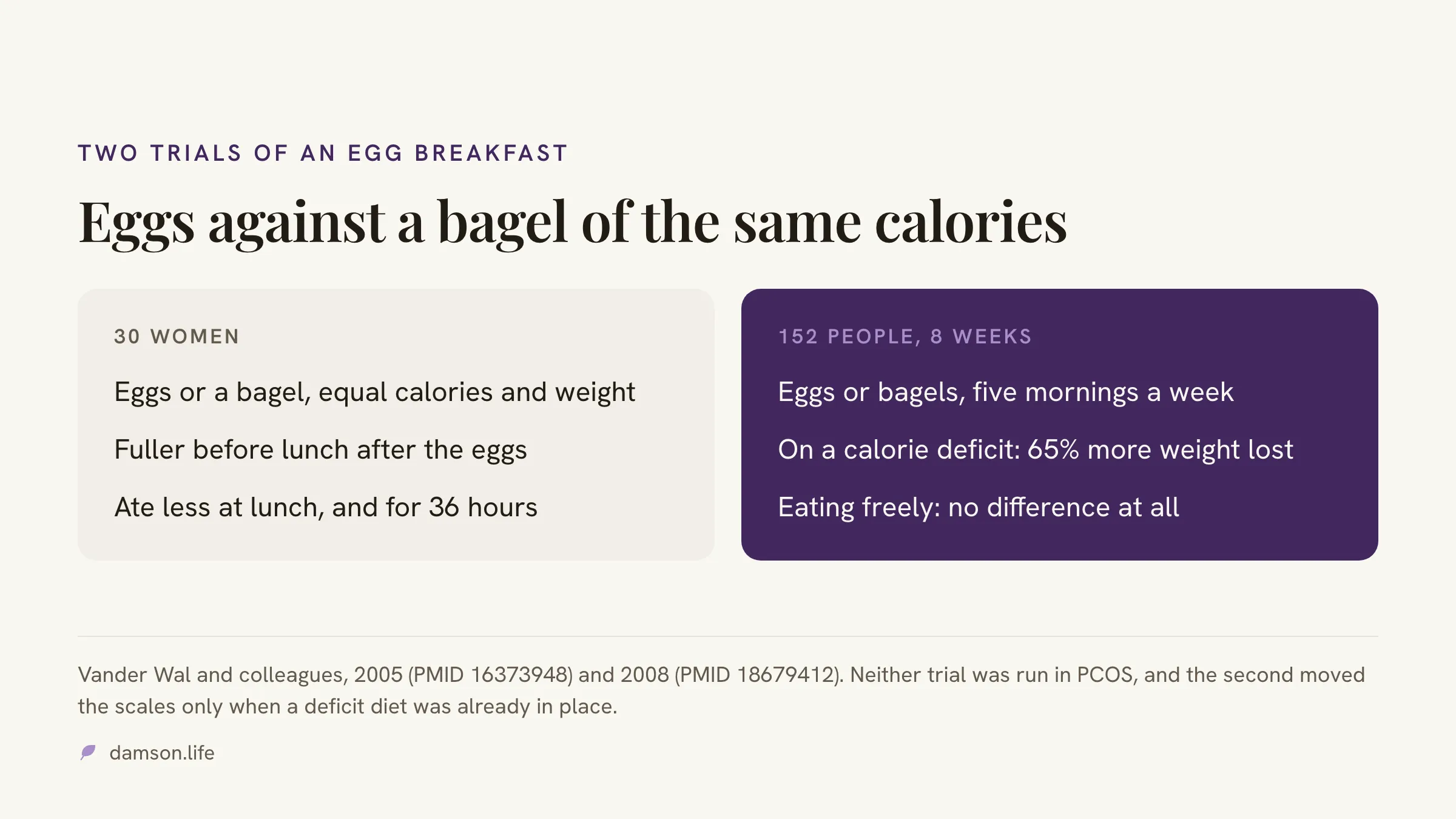
The egg breakfast only moved the scales when a calorie deficit was already in place.
What the evidence actually supports
The 2023 international guideline for this condition runs to 254 recommendations and practice points, puts eating and other lifestyle changes at the front of care, and describes its own evidence base as generally low to moderate quality. It does not mention eggs. It does not name any single food, because the systematic review commissioned to inform it compared diets of different composition and found that improvements happened regardless of composition. No one pattern came out ahead, and the trials it gathered were small, short, and not designed to tell you what two eggs do for your Tuesday.
So the honest position is this. There is good reason to care about how you eat. There is no evidence that eggs, specifically, are either the problem or the answer.
If you searched for eggs and PCOS and meant the other kind of egg, this page is about the ones in the fridge.
What is actually in an egg
An egg is mostly protein and fat, with almost no carbohydrate and no fibre. In the USDA reference data, one large egg carries about six grams of protein and five grams of fat for around 72 calories, most of the fat in the yolk, along with choline, vitamin D, and vitamin B12.
That composition is the whole reason eggs come up so often in advice for this condition. Protein is the component that most reliably makes a meal feel like a meal, and most breakfasts, toast, cereal, porridge, a pastry on the way in, carry very little of it. Eggs are the cheapest and quickest way to put some there. That is a real point about eggs. It is not a point about the condition.
What the trials measured: fullness, mostly
Three trials are worth knowing, because they tested what people are really asking, which is whether an egg breakfast lasts the morning.
In the first, 30 women aged 25 to 60 ate either an egg breakfast or a bagel breakfast of the same calories and the same weight, in random order two weeks apart, with lunch three and a half hours later. Before lunch they reported greater fullness after the eggs, and at lunch they ate significantly less, around 22 per cent fewer calories. Their intake stayed lower for the rest of the day and, on their own recall, for the following 36 hours.
In the second, 21 men ate an egg breakfast or a bagel breakfast matched for calories, a week apart, followed by a buffet lunch three hours later. After the bagel they were hungrier and less satisfied at three hours, ate more at the buffet, and ate more over the following 24 hours. The hunger hormone ghrelin was lower after the eggs, which fits what people felt. If ghrelin is new to you, why PCOS makes you hungry is where it is explained properly.
The third is the one that gets misquoted. 152 overweight adults were assigned to an egg breakfast or a bagel breakfast of the same calories for at least five mornings a week over eight weeks, with half of each group also asked to cut their intake by a thousand calories a day. Among those on the deficit, the egg group lost 65 per cent more weight, 2.63 kilograms against 1.59. Among those eating freely, the egg breakfast made no difference at all. Cholesterol did not differ between groups. So the headline, eggs for weight loss, is a headline about a deficit diet with eggs in it, not about eggs.
All three were short, none was in this condition, and the biggest was still only 152 people. That is a modest evidence base. It is also exactly the question you were asking, measured in the hours after breakfast rather than in a lab value you cannot feel.
The cholesterol question, answered in large numbers
The worry on the other side is that a daily egg is a risk to the heart, and it has been tested at scale.
Three US cohorts followed 83,349 women, 90,214 women and 42,055 men for up to 32 years. Eating at least one egg a day was not associated with cardiovascular disease, once the other habits that tend to travel with egg eating were accounted for; the hazard ratio was 0.93, with a confidence interval from 0.82 to 1.05 that comfortably includes no effect. The same paper pooled 33 risk estimates from cohorts totalling 1.72 million people and found that one extra egg a day was not associated with cardiovascular disease, with a relative risk of 0.98.
Earlier studies in people with diabetes had produced conflicting results, which is why a trial was run there. 140 people with type 2 diabetes or prediabetes were randomised to twelve eggs a week or fewer than two for three months, with both groups coached towards the same protein intake and better fats. HDL cholesterol did not differ, nor did total cholesterol, LDL or triglycerides, and the high-egg group reported less hunger after breakfast. This matters here because the 2023 guideline lists higher metabolic and cardiovascular risk among the features of the condition, so the people who most need the cholesterol question answered are close to the people it was answered in.
None of this says eggs are protective. It says that, across the largest studies we have, eating them regularly did not show up as harm, including in a group with diabetes. If you already have raised cholesterol or a family history of early heart disease, that is a conversation for your clinician, not for a web page.
The rest of the plate does more work than the egg does
If you take one thing from this page, take this. The interesting variable is almost never the egg on its own. It is what the egg arrives with.
An egg brings protein and fat and nothing else, so what it needs beside it is the fibre it lacks. Two eggs with a slice of toast and nothing green is a different breakfast from the same two eggs with spinach, tomatoes, beans, or a piece of fruit, even though the eggs are identical. Vegetables and pulses add volume and fibre for very little else, and fibre is the second of the two things, with protein, that most reliably extend how long a meal holds you. A fat with some substance, olive oil, avocado, a spoon of tahini, does something similar, though eggs already carry their own.
The order can matter too. If eggs are part of a plate with bread or potatoes, eating the egg and the vegetables first and the bread last is a small habit that costs nothing and that some people find changes the morning. We cannot tell you it will change yours, and no trial in this condition has looked.
None of this is specific to this condition and we will not pretend it is. It is ordinary composition and ordinary satiety, and it happens to be exactly the part of eating that most people notice within an hour or two, which is what makes it the part worth paying attention to.
How many, without arithmetic
There is no guideline number for eggs, and anyone who gives you one is guessing. The trials used two eggs at breakfast; the cohorts found no signal at one a day; the diabetes trial used twelve a week without harm. That is a wide and comfortable range.
The more useful question is not how many, it is what the egg is doing on the plate. If it is the protein in a breakfast that otherwise had none, it is doing a job. If it is the third egg on top of a plate that already had sausages and bacon, it is not the egg that needs thinking about.
Why the real answer is personal
Everything above is a general statement, and general statements have a ceiling. They can tell you that an egg breakfast held 30 women longer than a bagel did. They cannot tell you whether two eggs at seven will get you to lunch, because nobody has measured you.
You are in a position to measure yourself, and it takes less effort than the internet suggests. Note the breakfast in enough detail to repeat it: how many eggs, how they were cooked, and what came with them. Then note how you felt two or three hours later, in your own words rather than as a number. Repeat the same breakfast on a few different mornings so you are comparing like with like. After three or four repetitions you will know more about eggs and you than any article can tell you, including this one.
That is what we built Damson to do. A few hours after you eat, the meal check-in asks one small question about how the meal sat, and over a few weeks the patterns page shows you which of your own breakfasts leave you comfortable until lunch and which do not. It is on the App Store for iPhone. A notes app and a little consistency will also get you most of the way.
Questions people ask
Are eggs good for PCOS? They are a quick, cheap source of protein with no fibre, and there is no trial showing they do anything specific for the condition. An egg breakfast held people longer than a bread one in three short trials, none of them in this condition. If eggs get you to lunch and you enjoy them, that is a good enough reason to keep them.
How many eggs can I eat a day with PCOS? No guideline sets a number. In the largest cohort studies, at least one egg a day was not associated with cardiovascular disease, and a three-month trial of twelve eggs a week in people with type 2 diabetes did not move cholesterol. If you already have raised cholesterol, ask your clinician rather than a web page.
Should I eat only the whites? The protein is split between white and yolk, and most of the vitamins, the choline and all of the fat sit in the yolk. The cholesterol studies above were done on whole eggs. Unless a clinician has given you a specific reason, there is no evidence that discarding the yolk gains you anything.
Why am I still hungry an hour after eggs? Usually because the plate had protein and little else. Eggs bring no fibre, so try the same eggs with something that does, vegetables, beans, a piece of fruit, a slice of good bread, and see whether the morning changes. If it does not, eggs may simply not be your breakfast, and that is allowed.
The bottom line
Eggs are not the problem, and they are not the answer. The guideline does not mention them, the review that informed it found no single dietary composition superior, and the trials that exist say two modest things: an egg breakfast tends to hold people longer than a bread one of the same calories, and eating eggs regularly did not show up as harm in the largest studies, including one in people with diabetes. Beyond that, put fibre beside them, keep the plate in proportion, and let your own record settle whether eggs are the breakfast that gets you to lunch.
Read next
The two grains people ask about most are covered the same way: can you eat rice with PCOS and is oatmeal good for PCOS.
If the reason you are asking about breakfast is that you are hungry by eleven, why does PCOS make me so hungry is the fuller answer, ghrelin included.
And if the thoughts about food are the harder part of the morning, what food noise is and what quietens it.
To find out which breakfast lasts your morning, Damson’s food scanner reads a photo of the plate in plain sentences, and a few hours later asks how it sat.
Sources
- Vander Wal JS, Marth JM, Khosla P, Jen KL and Dhurandhar NV, short-term effect of eggs on satiety in overweight and obese subjects, Journal of the American College of Nutrition 2005 PMID 16373948
- Vander Wal JS, Gupta A, Khosla P and Dhurandhar NV, egg breakfast enhances weight loss, International Journal of Obesity 2008 PMID 18679412
- Ratliff J and colleagues, eggs for breakfast compared with a bagel breakfast in 21 men, appetite and intake over the following 24 hours, Nutrition Research 2010 PMID 20226994
- Drouin-Chartier JP and colleagues, egg consumption and risk of cardiovascular disease, three large prospective US cohort studies, systematic review and updated meta-analysis, BMJ 2020 PMID 32132002
- Fuller NR and colleagues, the effect of a high-egg diet on cardiovascular risk factors in people with type 2 diabetes, the DIABEGG study, a three-month randomised controlled trial, American Journal of Clinical Nutrition 2015 PMID 25833969
- Teede HJ and colleagues, recommendations from the 2023 international evidence-based guideline for the assessment and management of polycystic ovary syndrome, Human Reproduction 2023 PMID 37580037
- Moran LJ and colleagues, dietary composition in the treatment of polycystic ovary syndrome, a systematic review to inform evidence-based guidelines, Journal of the Academy of Nutrition and Dietetics 2013 PMID 23420000
- USDA FoodData Central, reference entry for whole raw egg
Damson is on the App Store.
Free to download, and the record is free to keep. No ads, and nothing to cancel later that you did not choose.