Best PCOS apps in 2026: food trackers honestly compared
The PCOS and PMOS food and nutrition apps you can download in 2026, with what each one verifiably does, what it costs, and who it suits.
There is no single best PCOS food tracker app, and a page that names one without saying what it is optimising for is selling you something. The apps sold for PMOS (formerly PCOS) are not doing the same job. Some log what you eat, some hand you a meal plan, some come with a human being, and one comes with a sensor you wear on your arm. Deciding which of those you want narrows the field faster than any ranking will.
We make Damson, a meal companion for PCOS on the iPhone. That makes us biased, so this page sticks to what each app verifiably does, and you can judge for yourself.
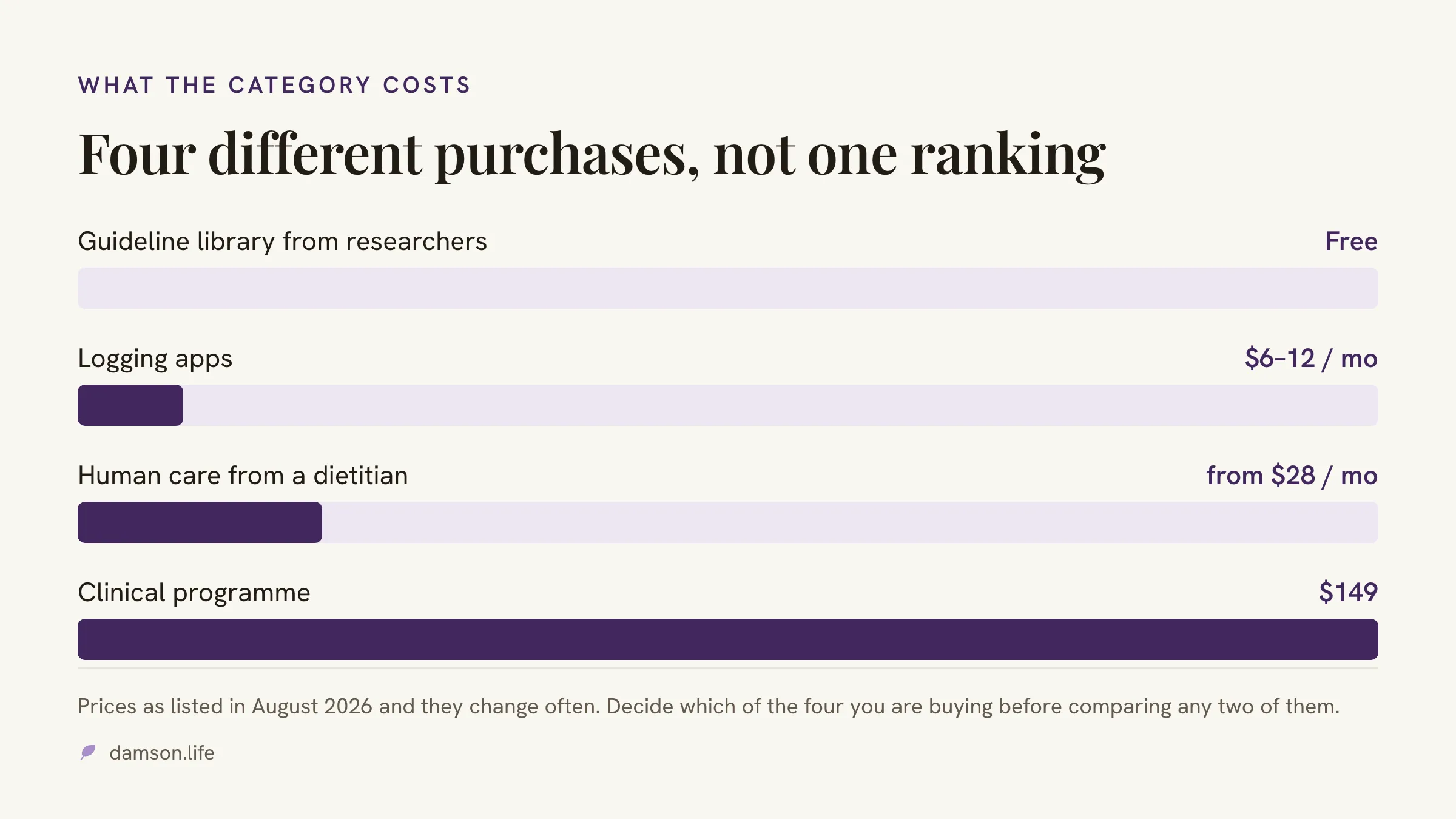
Four different purchases, and the prices are not comparable across them.
What an app can and cannot do here
Worth settling before the list, because it decides which of these could possibly suit you.
An app can hold a record, show you what is in it, and put something in front of a clinician that is better than memory. What no app has been shown to do is change the outcomes people most want changed. The Cochrane review of lifestyle treatment in this condition gathered fifteen randomised trials covering 498 women, and reported that not one of them had measured live birth or miscarriage, and not one had reported menstrual regularity. What it did find was a modest reduction in weight and body mass index, and a modest fall in the free androgen index, all of it rated low quality. Two of that review’s authors went on to write the 2023 international guideline, which endorses no particular way of eating either.
So the ceiling is the same for everything on this page, ours included. Damson reads plates and remembers how they sat. It is not a treatment, and nothing you can download is.
How we checked
Everything below comes from each app’s own App Store listing or developer site, read in August 2026. Prices are the United States listings and change often. Where a company does not publish a price we say so rather than inventing one, and where a claim could not be checked, we left it out.
| App | What it is | Price as listed |
|---|---|---|
| AskPMOS (formerly AskPCOS) | Guideline library, symptom tracker, forum. No food log | Free, no in-app purchases |
| Balance: PCOS Nutrition | Meal plans, scanner, meal log | $5.99 weekly to $69.99 yearly |
| NutriScan for PCOS | Photo scan, macros, 28 day plans | 7 day trial, then not published |
| PCOS Polly | Meal log, recipes, symptoms, habits | $9.99 to $79.99 |
| PCOS Pal | Lessons, meal plans, scanner | Weekly from $3.99, yearly $69.99 |
| PCOS Tracker App | Food, weight, water, statistics | $11.99 to $89.99 |
| Cysterhood | Recipes, workouts, live coaching | $27.99 to $29.99 monthly |
| Allara Health | Clinic with a dietitian, not an app | $149 monthly, or insurance |
| Pollie | Care platform, coaching and labs | Not published |
| Aspect Health | Coached programme around a sensor | Not published |
| Go Go Gaia | Cycle tracker with nutrition | Free core, PRO about $9.99 |
| Damson | Ours. Meal record, plate reads, check ins | Free record, full app $9.99 monthly or $49.99 yearly |
The free one, built by researchers
AskPMOS, until recently AskPCOS, comes from the Monash Centre for Health Research and Implementation, the group behind the international guideline. It is free, with no in-app purchases on the listing, and it does what a research group would build: plain explanations tied to the 2023 guideline, a symptom tracker, a dashboard, a list of questions to take to an appointment, and a moderated forum.
What it is not is a food tracker. There is no meal log and no scanner, so if logging is what you came for, this is a companion to something else. One detail worth reading before you assume free and academic means minimal: its privacy label reports health data, contact information and user content linked to your identity.
The ones that log what you eat
Balance: PCOS Nutrition builds meal plans from your health data, your preferences and what is in your cupboard, scans food, logs custom meals and can read from Apple Health. Its scanner is sold weekly at $5.99, monthly at $7.99 and yearly at $69.99, with a one time option at $29.99. It explains foods in terms of insulin and inflammation, a stronger claim than we would make from a photograph of a plate, though it is clear about doing it. Its privacy label reports usage and advertising data that may be used to track you across other apps and websites. A footnote for anyone following the rename: this app was listed for a while as “PMOS - PCOS Food Tracker” and has since gone back to the older term.
NutriScan for PCOS is the scanner taken seriously: photograph a meal, get calories, macros and micronutrients, with 28 day meal plans and a chat assistant. Its own page puts fibre and protein alongside carbohydrate, which is the more honest end of nutrition tracking. There is a seven day trial, and the ongoing price was not published on the page we read, which is the one thing we would want fixed before subscribing.
PCOS Polly describes itself as an all in one tracker: meals with a large recipe library, symptoms and cycles, supplements, sleep, movement and workouts. Subscriptions run from $9.99 monthly to $79.99 annually, and its privacy label reports health data, contact information, purchase history and user content linked to your identity. Note the name: it is easily confused with Pollie, a different company doing a different thing.
PCOS Pal from Slayyy, Inc. leads with lessons its listing says were reviewed by an obstetrician gynaecologist and an endocrinologist, alongside meal plans with grocery lists, a food scanner and a weight tracker. It holds 4.7 out of 5 from around 2,200 ratings, the strongest reception in this group, and pricing is unusually spread: weekly from $3.99, a month at $19.99, a year at $69.99, and lifetime access between $69 and $199. If you learn well from structured lessons, this is the one built that way.
PCOS Tracker App from Healthium, Inc. tracks food, weight and water with statistics and daily suggestions, on subscriptions from $11.99 to $89.99. It sits at 3.2 out of 5 from 298 ratings, and the reviews are specific about why: charges after cancelling, subscriptions that do not appear in the Apple subscriptions list, food that can only be logged in ounces, one ingredient at a time, and no way to fix an entry once it is wrong. We cannot verify any single account, but the pattern is consistent enough that we would test the cancellation route early.
The ones that come with a person
Cysterhood was built by Tallene Hacatoryan, a registered dietitian who has the condition herself. A short quiz leads to meal plans, more than 250 gluten and dairy free recipes, a workout library, weekly live group coaching and a community. It is $27.99 to $29.99 a month or $149.99 to $214.99 a year, and holds 4.6 out of 5 from 636 ratings. Its privacy label is the strictest here: the developer states that no data is collected from the app. The gluten and dairy free framing is a philosophy rather than a guideline position, so it suits someone who wants that structure and will frustrate someone who does not.
Allara Health is not really an app, it is a virtual clinic. Membership pairs you with one medical provider and one registered dietitian you keep seeing, plus labs and medication management, across 45 states and Washington DC, with nutrition only membership in five more. It is in network with Aetna, Blue Cross Blue Shield, Cigna, United Healthcare and GEHA, and self pay is $149 a month for complete care or $125 for nutrition alone. If what you want is a clinician who answers your messages, no tracker competes.
Pollie also puts people first: labs, a care plan, coaching and small group sessions through its own app, running since 2020. Its site would not load on the day we checked, and the most recent membership price we found was $65.99 a month, recorded by CB Insights in 2023, which may be out of date. Treat that as a question to ask rather than a quote.
The one built around a sensor
Aspect Health runs a coached programme in which, in its own words, “a small sensor measures your glucose levels 24/7 and sends the data directly to your Aspect Health app”, with coaches and algorithms working from what the sensor sees. The app is free and the programme is not: the science page advertises a sale rather than a price, and users describe monthly costs from $60 to $119 and upward, often with sensors billed separately. Its privacy label reports health and fitness data, location and sensitive information linked to your identity, with location possibly used to track you across other apps.
It is the most data rich option here and the most expensive way in, and it suits someone who wants continuous readings and has been advised they are useful for her. We build differently, and our editorial policy says why.
The cycle tracker with nutrition attached
Go Go Gaia, from Holland Neurotech Inc., is a cycle and symptom tracker that logs nutrition too, with more than twenty trackable symptoms, wearable integration, lab and medication records and correlation views across the lot. Core tracking is free, PRO is about $9.99 a month or $49.99 a year, and it is iOS only. Worth noting in a category full of self serving lists: their own comparison page states plainly that it is published by the company behind the app. We wish that were less rare.
Where Damson sits
Damson is ours, and it is new on the App Store. It is a meal companion rather than a counter: you record what you ate and how you felt afterwards, it explains the plate in terms of composition and fullness, and you can correct anything it gets wrong. Each part of it has its own page under everything Damson does.
None of that puts it above the apps that have been around for years and have real people relying on them. The record is free, so it costs nothing to try it alongside them and keep whichever suits you.
Questions people ask
Is there a free PCOS food tracker app? There are free apps and there is free food tracking, rarely both in one. AskPMOS is genuinely free and does not log meals, while the logging apps are free to install with the useful part behind a subscription. A general purpose food diary you already trust, used alongside AskPMOS, is a reasonable free combination.
Which app is best if I only want to log meals? Look at Balance: PCOS Nutrition, NutriScan for PCOS and PCOS Polly first, because logging is the centre of what they do. Then try the correction flow on day one: log something wrong on purpose and see how hard it is to fix.
Are PCOS apps worth paying for? It depends what you are buying. Coaching from a registered dietitian at $27.99 a month is a different purchase from a scanner at $7.99, and both differ from a clinic at $149. Decide which of the three you need before comparing prices.
Is there a PMOS app? The same apps. PMOS is the new name for PCOS, agreed in May 2026, and nothing about the condition changed with it, so a PMOS app and a PCOS app are the same thing. The store listings have mostly not caught up: at the time of writing the Monash guideline library is the one that has renamed, from AskPCOS to AskPMOS. If you search the App Store for PMOS you will find very little, so search the old name for now.
The bottom line
The category splits four ways: a free library from researchers, logging apps at roughly $6 to $12 a month, human care from about $28 a month up to $149, and one sensor led programme that costs the most. Pick the row you actually need, then read the privacy label and find the cancel button before you enter a card. That habit will serve you better than any ranking, including this one.
Read next
If a ranking was not what you needed, the six questions that decide whether a food diary survives a normal month is the other way to choose.
The name on all of these listings is changing: PCOS is now also called PMOS.
And for what a food record is actually good for, why do I get bloated after eating is the clearest example.
Sources
- AskPMOS, Monash Centre for Health Research and Implementation, official app site
- AskPCOS on the App Store, listing by Monash University (free, no in-app purchases listed)
- Balance: PCOS Nutrition on the App Store, listing by Josephine Kisiwaa Gyamera
- NutriScan for PCOS, product page on the developer's own site
- PCOS Polly on the App Store, listing by Akshaya Dinesh
- PCOS Pal on the App Store, listing by Slayyy, Inc.
- PCOS Tracker App on the App Store, listing by Healthium, Inc.
- PCOS Tracker App, App Store ratings and reviews page
- Cysterhood: PCOS Weight Loss on the App Store, listing by Tallene Hacatoryan Inc
- Allara Health, insurance and pricing page
- Allara Health, how it works page
- Pollie company profile, CB Insights
- Aspect Health, the science behind the Aspect protocol
- Aspect Health on the App Store, listing by Aspect Health Global Inc.
- Go Go Gaia, best PCOS tracking app guide, published by Holland Neurotech Inc.
- Lifestyle changes in women with polycystic ovary syndrome, Lim SS and colleagues, Cochrane Database of Systematic Reviews 2019 PMID 30921477
- Recommendations From the 2023 International Evidence-based Guideline for the Assessment and Management of Polycystic Ovary Syndrome, Teede HJ and colleagues, J Clin Endocrinol Metab 2023 PMID 37580314
Damson is on the App Store.
Free to download, and the record is free to keep. No ads, and nothing to cancel later that you did not choose.
Download on the App Store