PCOS meal plan: free 7-day week with grocery list
A free 7-day PCOS meal plan of real lunches and dinners, with a grocery list by aisle, cook-once leftovers and vegetarian, gluten-free and dairy-free swaps.
A good PCOS meal plan is an ordinary week of good food that you will actually cook. PCOS is now also called PMOS, and under either name the 2023 international guideline does not prescribe one diet. It recommends general healthy eating that suits you and that you can keep up. So the useful thing is not a list of rules. It is a real week, with the shopping already worked out.
Below is one: seven days of lunches and dinners, the grocery list for the whole week grouped by aisle, three dinners cooked once and eaten twice, and the swaps for vegetarian, gluten-free and dairy-free weeks. Every plate is a real recipe from Damson’s meal planner, with about how long it takes. Nothing here counts calories, and you do not need the app to use any of it. If you would rather have a week planned around the foods you skip, Damson plans your first week free, right in your browser.
What should a PCOS meal plan include?
A PCOS meal plan should be built from plates you enjoy, with protein, fiber and vegetables on most of them and carbohydrates that come mostly whole. That is not a special PCOS diet. It is what the evidence supports.
The 2023 international guideline, the largest body of PCOS advice there is, puts eating and other lifestyle habits at the front of care and recommends general healthy eating principles rather than any particular diet. The systematic review commissioned to inform it compared diets of different composition in PCOS and found that improvements happened regardless of composition: no single pattern came out ahead. That is why this plan has no banned foods and no food called good or bad.
What it does have is a shape, the same on every plate:
- Protein, from chicken, turkey, fish, shrimp, a little lean beef, cheese, or beans and lentils. Protein is the part that most reliably makes a meal feel like a meal.
- Fiber, mostly from beans, chickpeas and lentils, which turn up at almost every lunch and dinner, and from vegetables and whole grains.
- Vegetables, at least one on every plate, often two or three.
- Carbohydrates that come mostly whole: brown rice, quinoa, whole wheat spaghetti, sweet potato, and the beans and lentils themselves.
A plate built that way tends to hold you until the next meal, and a week built that way is easy to repeat. That is the whole design. It is not a treatment, and if you have a dietitian or a doctor guiding what you eat, their advice comes first.
A 7-day PCOS meal plan
This week is for one person who skips nothing and likes leftover lunches. Three dinners are cooked as two portions, and the second becomes the next day’s lunch, so on three days there is nothing to cook at midday.
| Day | Lunch | Dinner |
|---|---|---|
| Monday | Tuna, corn and kidney bean salad, 10 min | Chicken, chickpea and spinach curry with brown basmati, 45 min, cooked for two |
| Tuesday | Monday’s curry, reheated | Salmon with green lentils and roasted zucchini, 30 min |
| Wednesday | Red lentil and red bell pepper soup, 35 min | Butter bean and tomato stew with quinoa, 35 min, cooked for two |
| Thursday | Wednesday’s stew, reheated | Chicken and chickpea sheet-pan bake with peppers, 45 min |
| Friday | Mozzarella, white bean and tomato salad, 10 min | Shrimp, pea and pepper brown rice, 40 min, cooked for two |
| Saturday | Friday’s shrimp rice, reheated | Turkey and lentil shepherd’s pie with mashed sweet potatoes, 70 min |
| Sunday | Butter bean, cucumber and feta salad, 10 min | Beef and lentil bolognese with whole wheat spaghetti, 40 min |
The names are the US English ones; in the UK the zucchini is a courgette, the shrimp are prawns and the sheet-pan bake is a traybake. Weekday lunches you have to make take ten minutes or come from last night, and the longest cooking, the shepherd’s pie, sits on Saturday.
What is on each plate?
Here is what goes into each plate, for one serving, so you can see the shape at work and cook it without a recipe card.
Monday lunch, tuna, corn and kidney bean salad. 90 g tuna, 100 g kidney beans, corn, red bell pepper and red onion, in olive oil, lemon and smoked paprika. Protein from the tuna, fiber from the beans.
Monday dinner, chicken, chickpea and spinach curry with brown basmati. 110 g chicken breast with 60 g chickpeas in a spiced tomato sauce with onion and 80 g spinach, over brown basmati rice. Make double: the second portion is Tuesday’s lunch.
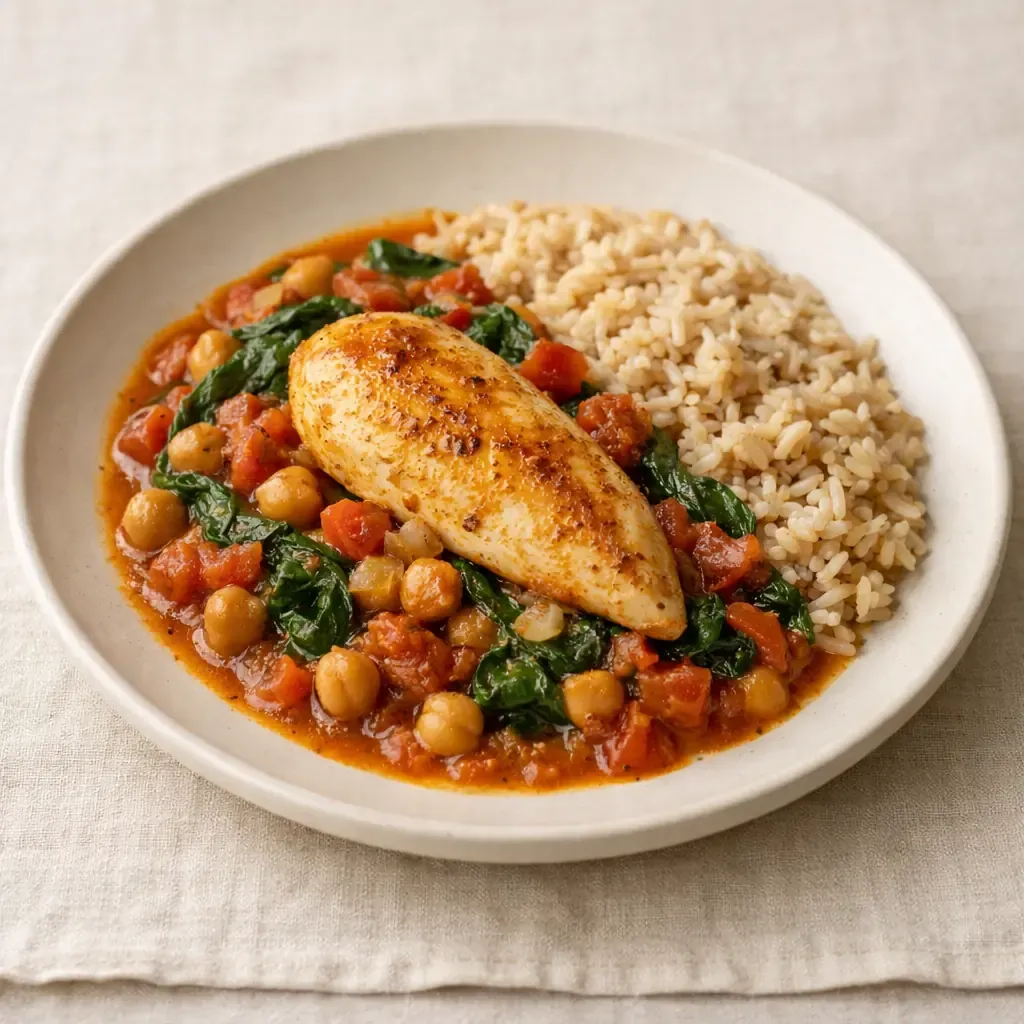
Monday dinner: chicken, chickpea and spinach curry with brown basmati. Recipe illustration from Damson’s planner, not a photo of a cooked dish.
Tuesday dinner, salmon with green lentils and roasted zucchini. 110 g salmon fillet baked with lemon, 100 g cooked green lentils with garlic and thyme, and 100 g roasted zucchini. Oily fish, a pulse and a vegetable in thirty minutes.
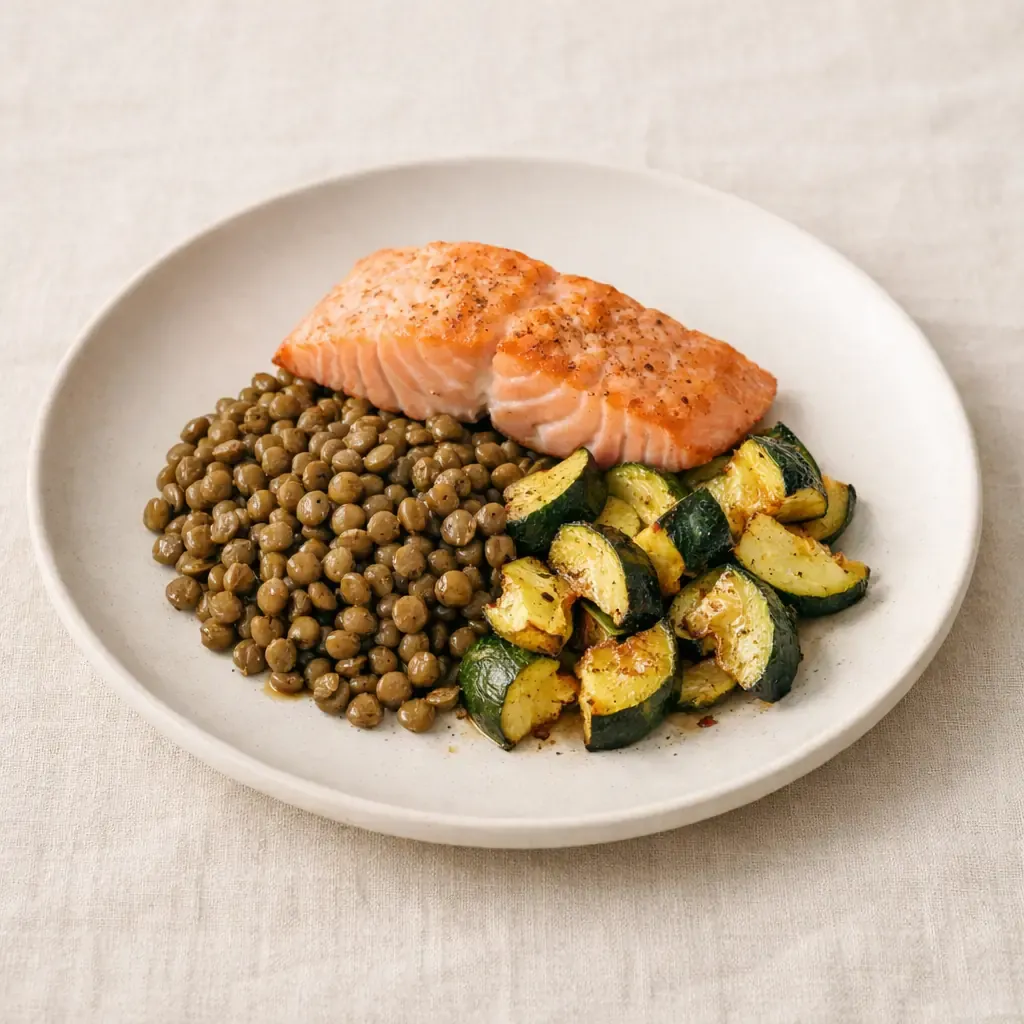
Tuesday dinner: salmon with green lentils and roasted zucchini. Recipe illustration from Damson’s planner, not a photo of a cooked dish.
Wednesday lunch, red lentil and red bell pepper soup. Red lentils simmered with red bell pepper, onion and tomatoes, blended smooth with smoked paprika. Most of the protein and fiber come from the lentils, so it is a full lunch, not a starter.
Wednesday dinner, butter bean and tomato stew with quinoa. 200 g butter beans with tomatoes, red bell pepper, onion and kale, over quinoa. A meat-free dinner with plenty of protein, cooked for two so Thursday’s lunch is done.
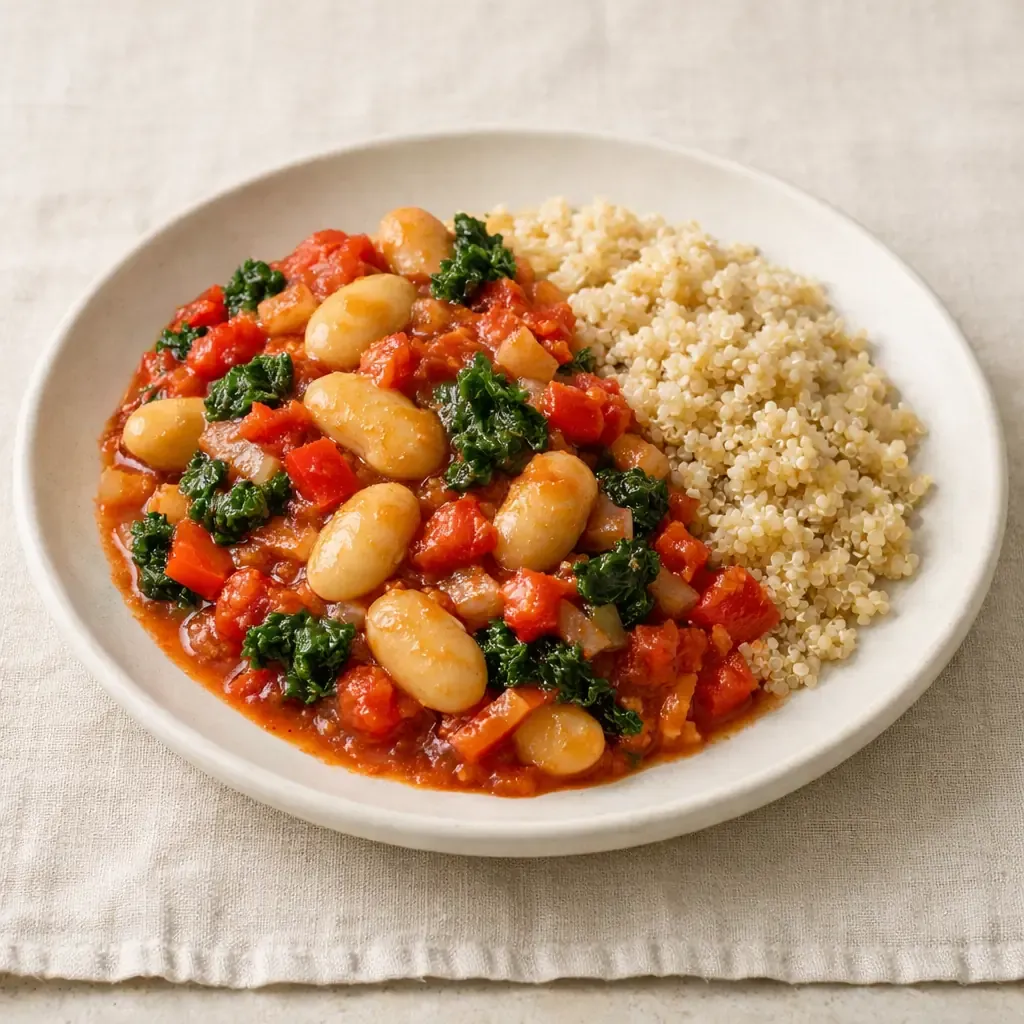
Wednesday dinner: butter bean and tomato stew with quinoa. Recipe illustration from Damson’s planner, not a photo of a cooked dish.
Thursday dinner, chicken and chickpea sheet-pan bake with peppers. 110 g chicken thighs roasted on one tray with 120 g chickpeas, red bell pepper and red onion, with cumin and smoked paprika. One tray, one wash-up.
Friday lunch, mozzarella, white bean and tomato salad. 60 g mozzarella torn over cannellini beans, cherry tomatoes and arugula, with olive oil and lemon.
Friday dinner, shrimp, pea and pepper brown rice. 100 g jumbo shrimp cooked through with brown rice, peas and red bell pepper, finished with paprika and lemon. Cooked for two for Saturday’s lunch.
Saturday dinner, turkey and lentil shepherd’s pie with mashed sweet potatoes. Diced turkey thigh and green lentils in a tomato gravy with carrot and onion, under mashed sweet potato. The slowest dish of the week, so it goes on the day with time.
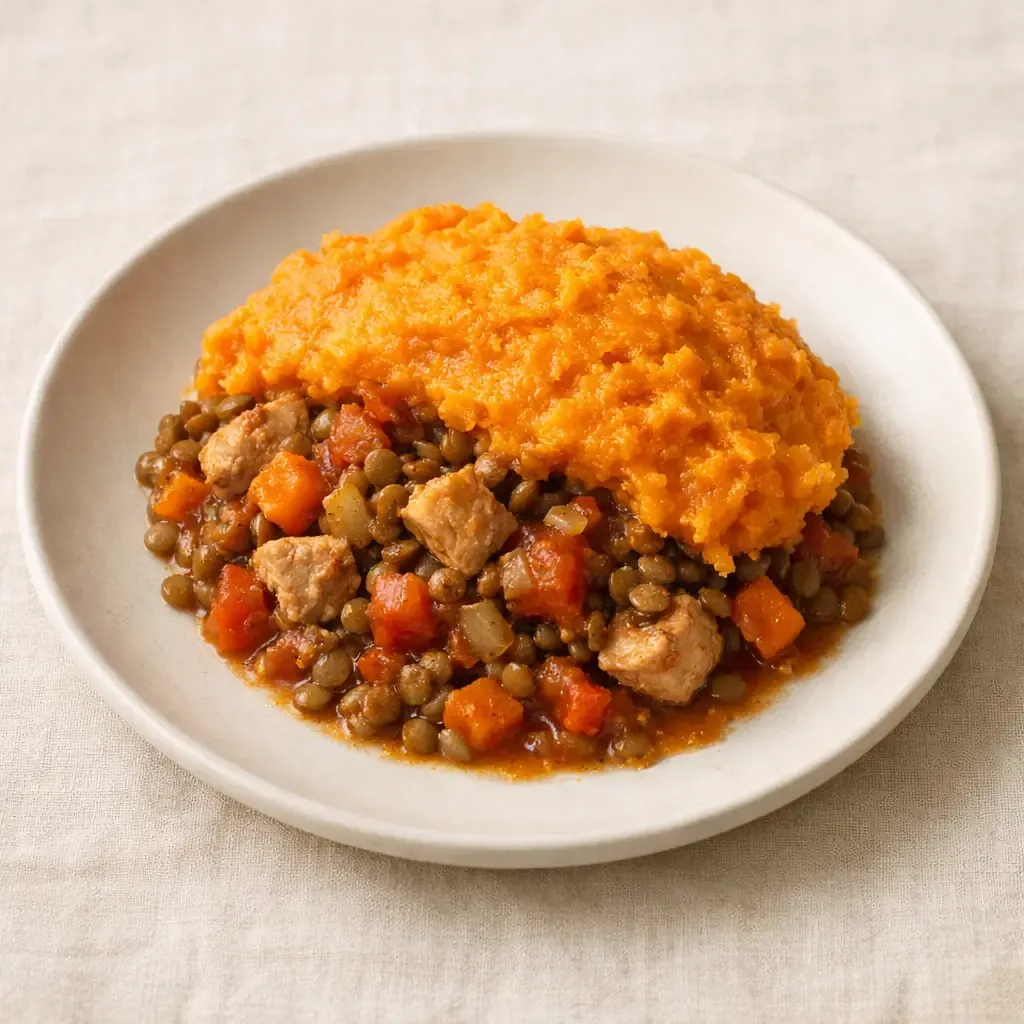
Saturday dinner: turkey and lentil shepherd’s pie with mashed sweet potatoes. Recipe illustration from Damson’s planner, not a photo of a cooked dish.
Sunday lunch, butter bean, cucumber and feta salad. 120 g butter beans with cucumber, cherry tomatoes, red onion and 40 g feta, in lemon and oregano.
Sunday dinner, beef and lentil bolognese with whole wheat spaghetti. 80 g extra lean ground beef stretched with green lentils in a tomato sauce with carrot and onion, over whole wheat spaghetti.
Count the pattern rather than the grams: beans, chickpeas or lentils on ten of the eleven plates you cook, fish or shrimp three times, poultry three times, red meat once, and a vegetable every time.
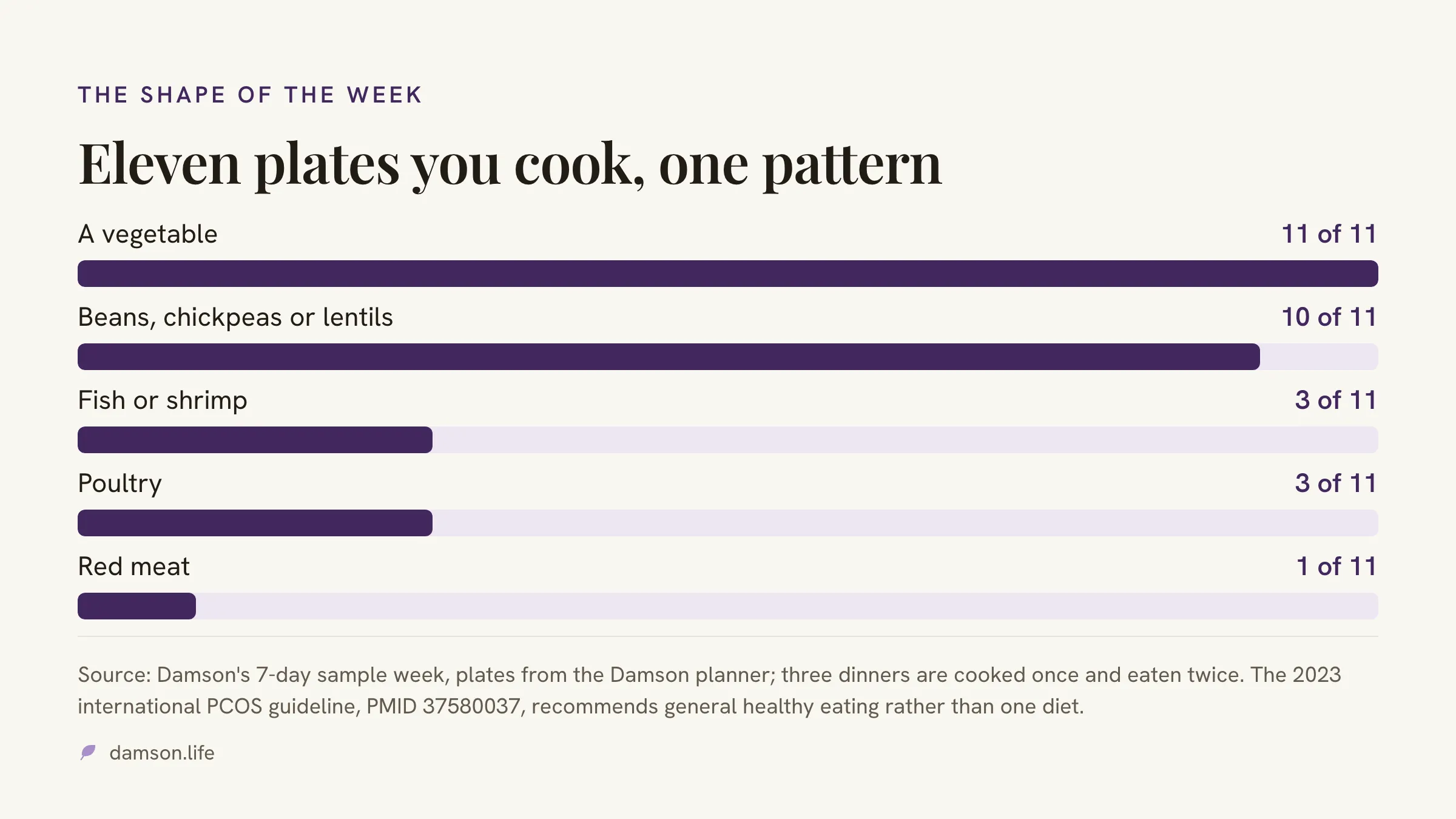
Fourteen meals, eleven plates to cook: three dinners are made once and eaten twice.
The grocery list, grouped by aisle
This is everything the week needs for one person, with the three doubled dinners already counted. Rice, quinoa and pasta are given at their dry weight, the way you buy them; beans and lentils are drained weights, so a can is usually about 240 g.
Vegetables, beans and lentils
- Chopped tomatoes, 870 g (about two 400 g or 14.5 oz cans)
- Butter beans, 520 g (about two cans)
- Red bell peppers, 510 g (about three)
- Onions, 330 g (about three)
- Green lentils, cooked, 260 g (a can or pouch)
- Chickpeas, 240 g (one can)
- Spinach, 160 g
- Peas, frozen, 160 g
- Cherry tomatoes, 160 g
- Carrots, 110 g (one or two)
- Red onion, 100 g (one)
- Kidney beans, 100 g, and cannellini beans, 100 g (half a can of each)
- Curly kale, 100 g
- Zucchini, 100 g (one small)
- Sweet potato, 200 g (one medium)
- Corn, 60 g, cucumber, 60 g, and arugula, 30 g
Fish
- Raw jumbo shrimp, 200 g
- Salmon fillet, 110 g
- Tuna in water or brine, 90 g drained (one small can)
Meat and poultry
- Chicken breast, 220 g
- Chicken thighs, 110 g
- Diced turkey thigh, 90 g
- Extra lean ground beef, 80 g
Dairy
- Mozzarella, 60 g
- Feta, 40 g
Grains and pasta
- Brown rice, about 210 g dry (basmati or regular)
- Quinoa, 120 g dry
- Red lentils, about 60 g dry
- Whole wheat spaghetti, about 70 g dry
Check the cupboard first
- Olive oil and a neutral oil such as canola
- Garlic, and three or four lemons
- Smoked paprika, ground cumin, coriander, turmeric and ginger, dried oregano and thyme, salt and black pepper
Cooking for two or more? Multiply everything except the cupboard. The same food used by two recipes is one row here, which is most of what makes a weekly list cheaper than shopping meal by meal.
Cook once, eat twice: leftovers done safely
Cooking a dinner as two portions is the easiest meal prep there is for PCOS lunches: no Sunday afternoon of boxes, just a little more in the pan three nights a week. It only works if the second portion is stored well, so follow the food safety basics every time.
- Cool it quickly. Portion the second serving into a shallow container as soon as you have served dinner, and get it into the fridge within two hours of cooking, or within one hour on a very hot day, above 90°F or 32°C.
- Rice needs more care. Cooked rice can carry spores that survive cooking, so cool it as fast as you can, ideally within an hour, keep it in the fridge and eat it within 24 hours. That is why the rice dinners here become lunch the very next day.
- Eat within a few days. Most cooked leftovers keep three to four days in the fridge. Everything in this plan is eaten the next day.
- Reheat once, until steaming hot. Heat the portion until it is steaming hot all the way through, 165°F or 74°C if you use a thermometer, stirring halfway in a microwave. Reheat it once only.
Not every dish suits a second day. Risottos, omelets and dishes with pan-fried garnish are better eaten fresh, which is why none of the cooked-for-two dinners above are those.
How to adapt the plan
What you skip should be absolute, so these swaps replace the whole plate rather than leave a gap. Each one is a real plate from the same planner, with the same shape.
Vegetarian. Six dinners and one lunch change:
- Monday’s curry becomes chickpea, cauliflower and pea curry with brown basmati, 40 min, still cooked for two.
- Tuesday’s salmon becomes smoky chickpea and spinach stew with brown basmati, 35 min.
- Thursday’s chicken becomes chickpea and roasted vegetable sheet-pan bake with quinoa, 40 min.
- Friday’s shrimp becomes kidney bean and rice stuffed peppers, 50 min, cooked for two.
- Saturday’s pie becomes green lentil shepherd’s pie with olive oil mashed potatoes, 60 min.
- Sunday’s bolognese becomes whole wheat spaghetti with lentil ragu, 35 min.
- Monday’s tuna salad at lunch becomes three-bean and quinoa salad, 20 min.
Gluten-free. Only one plate in the week has gluten: Sunday’s bolognese, because of the spaghetti. Swap it for cod in a chickpea and tomato stew, 30 min. Everything else is built on rice, quinoa, potatoes and pulses.
Dairy-free. Two lunches carry cheese. Friday’s mozzarella salad becomes chickpea, avocado and tomato salad with brown rice, 15 min, and Sunday’s feta salad becomes pea, spinach and white bean soup, 25 min. The protein in both comes from the beans.
If you skip more than one group, apply the swaps together and check each plate again. When the rules leave a day short, leave it open for a meal you already like rather than bending a rule to fill it.
Breakfast and snacks
The plan covers lunch and dinner because those are the meals that need a list. Breakfast tends to be the same few things on repeat, and that is fine. The same shape helps here: put some protein and some fiber in it. Oats with Greek yogurt and berries, eggs with spinach or beans on whole wheat toast, or yogurt with fruit and a handful of nuts all do it. If breakfast is the meal you wonder about, we looked at the trials for eggs and for oatmeal.
Snacks are optional. If you are hungry between meals, fruit with nuts, hummus with vegetables, or a yogurt will carry you to the next plate. If you are hungry an hour after most meals, that is worth looking at on its own, and why PCOS makes you hungry is where we go through it.
Your own week, planned for you
This sample is a fixed week, and your own is not. You skip different foods, cook for different people and like different dinners, and next week should know which of this week’s plates sat well with you.
That is what Damson’s meal planner does. You tell it what you skip, who you cook for and whether you want leftover lunches, and it plans seven days of lunches and dinners from the same plates you see here, with every recipe step by step and one shopping list for the week, grouped by aisle and sized for your table. Dinners cooked for two say how to cool, store and reheat the second portion, the portions you cook wait in Ready to eat so a later lunch is logged in one tap, and Swap trades any meal for another that fits your rules. A recipe you found on any recipe site, TikTok or Instagram can go straight into the week, or into Your recipes for later.
Want an app to plan the week and make the shopping list for you? Here is how the best app for PCOS meal planning options compare.
Your first planned week is free in full: every recipe, every swap and the whole week’s shopping list. After that, today’s recipe and today’s shopping list stay free every day, and Damson Plus opens the rest of the week. Damson is a planner and food diary, not medical advice, and it is on the App Store for iPhone. You can also plan your first week free in your browser, on any phone or computer.
Questions people ask
What is the best meal plan for PCOS? The one you can keep up. The 2023 international guideline recommends general healthy eating rather than one diet, and the review behind it found no single dietary composition came out ahead. A week of plates with protein, fiber, vegetables and mostly whole carbohydrates, built from foods you like, is a sound default.
Do I need to count calories on a PCOS meal plan? No. This plan has no calorie targets, and Damson never counts calories. The plates are given in grams for one serving so you can cook and shop, not so you can add them up.
Is a PMOS meal plan different from a PCOS meal plan? No. PMOS is the new name for PCOS, agreed in 2026. Nothing about the condition or about eating with it changed with the name, so the same week works under either.
Do I have to cut out gluten or dairy with PCOS? Not for PCOS itself: the guideline does not single out gluten or dairy, and recommends general healthy eating instead. If you skip them because they do not suit you, or for another reason, the swaps above keep the week whole without them.
How do I meal prep for PCOS without spending Sunday cooking? Cook some dinners as two portions and eat the second for lunch the next day, as this plan does three times. Cool the second portion quickly, keep rice no longer than a day, and reheat once until steaming hot.
Can I repeat the same week? Yes. Repeating a week you liked halves the thinking, and the grocery list stays the same. Swapping one or two plates a week keeps it from getting stale.
The bottom line
A PCOS meal plan does not need special foods or a calorie target. It needs plates with protein, fiber and vegetables, carbohydrates that come mostly whole, a grocery list that covers the week, and a few dinners cooked twice so lunch takes care of itself. Cook the week above as it is, swap what you skip, and keep the plates that sit well with you. If you would rather have the next week planned around those, the planner does it, and the first week is free. It works on iPhone and in your browser.
Read next
The foods people ask about most, one at a time: can you eat rice with PCOS, are eggs good for PCOS and is oatmeal good for PCOS.
If you are choosing between meal planning apps, the best PCOS apps compared goes through what each one does and costs.
Sources
- Teede HJ and colleagues, recommendations from the 2023 international evidence-based guideline for the assessment and management of polycystic ovary syndrome, Human Reproduction 2023 PMID 37580037
- Moran LJ and colleagues, dietary composition in the treatment of polycystic ovary syndrome, a systematic review to inform evidence-based guidelines, Journal of the Academy of Nutrition and Dietetics 2013 PMID 23420000
- USDA Food Safety and Inspection Service, leftovers and food safety
- Food Standards Scotland, rice: cooling, storing and reheating cooked rice safely
- Public Health England, McCance and Widdowson's The Composition of Foods Integrated Dataset 2021, the food composition tables behind the plate amounts in this plan
Damson is on the App Store. Plan your first week free, in your browser.
Free to download, and the record is free to keep. No ads, and nothing to cancel later that you did not choose.
Lunches and dinners around the foods you skip, with the recipes and one shopping list, on any phone or computer.